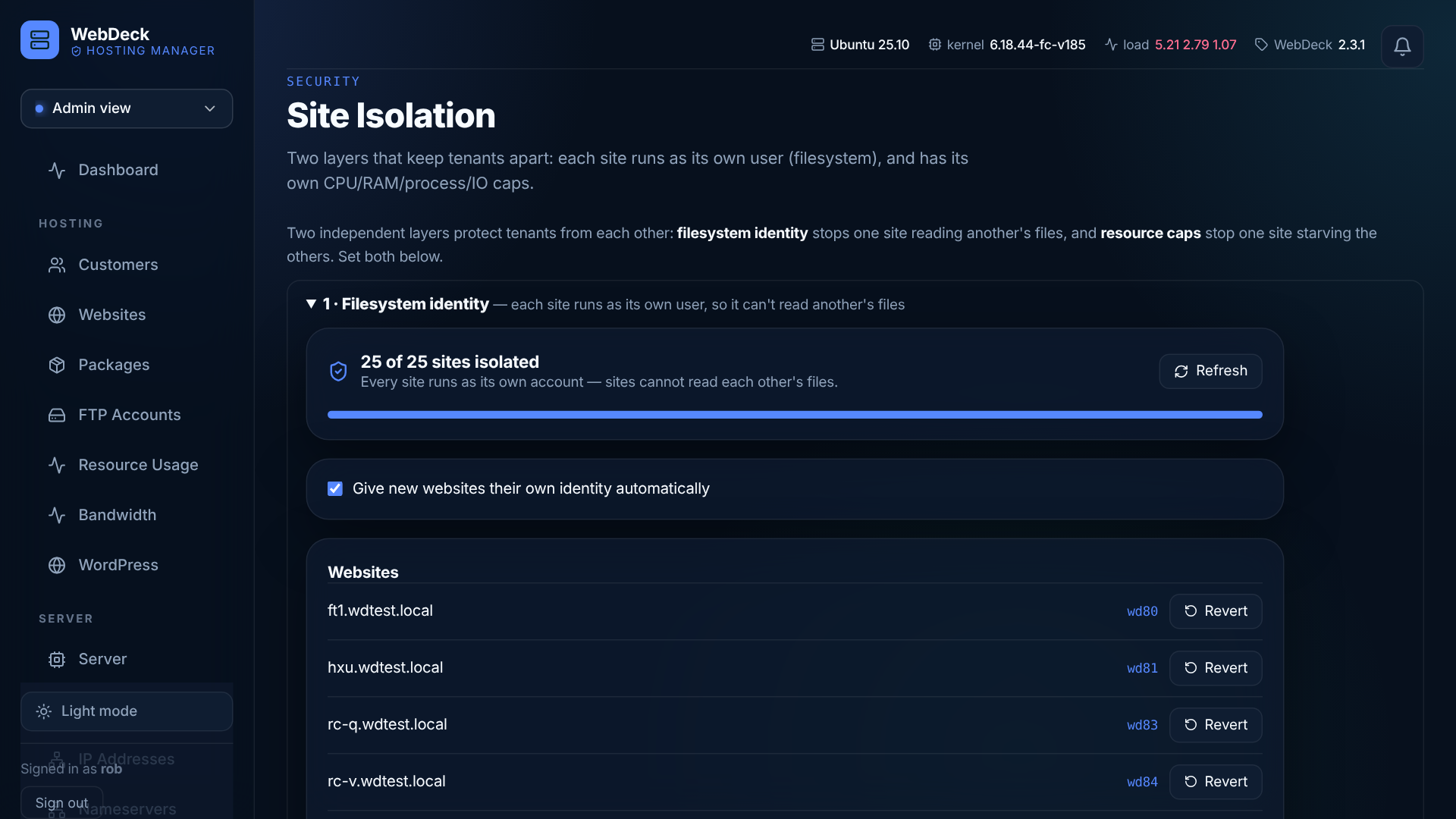
Account isolation
Customers confined to their own files, unable to see each other, and unable to hog the box. Kernel-enforced resource caps — the thing people buy CloudLinux for, built in. Since 2.2.0 each site's caps, PHP version, modules and settings all live on one per-site environment, so isolation is complete. No CloudLinux licence, and SELinux stays enforcing.
- Real per-site CPU, RAM, process & disk-I/O caps — enforced by the Linux kernel, not just PHP
- Give any site its own capped PHP process so it can't starve the others
- SELinux stays enforcing — unlike cPanel and CyberPanel, nothing gets disabled
- No CloudLinux required — the per-tenant isolation is included
- View history — RAM and process usage graphs per isolated site, over hours or days
- Isolation control centre — set caps per site or per account, with bulk actions and defaults
- Confined to their own files — automatic on every new SFTP/SSH account
- OpenLiteSpeed kept to one customer — its shared PHP user can't be used to mix customers on one server 2.3.0
- Self-healing — a per-site pool can never take down the shared server; the panel repairs itself on boot
- Works across Debian and RHEL-family Linux — not just one distro
Per-site PHP environments
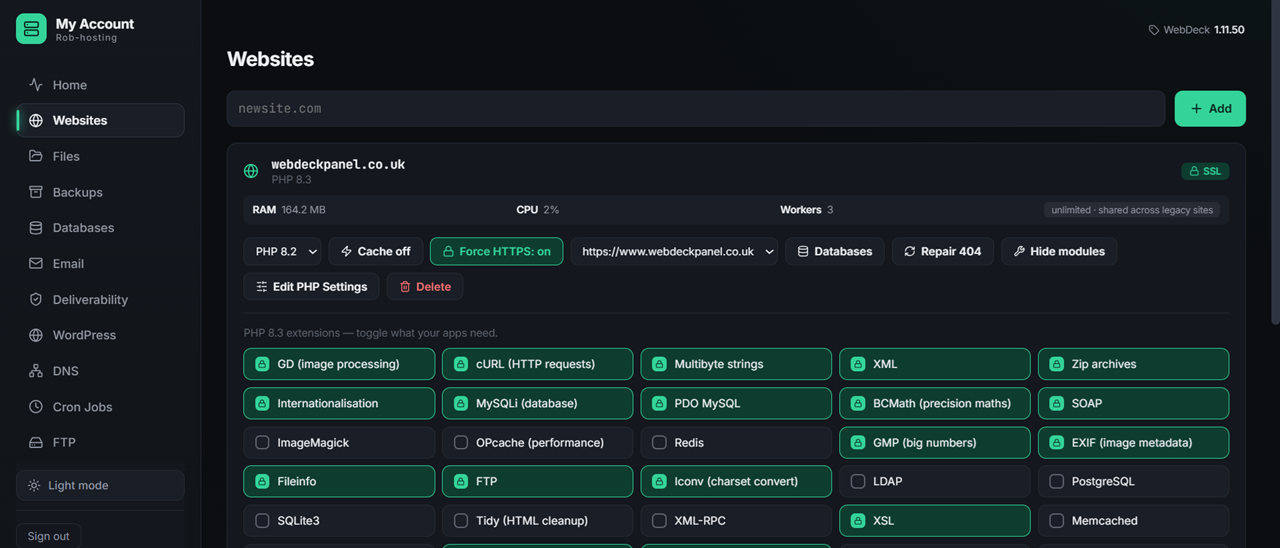
The headline feature, and the one cPanel needs CloudLinux for. Every website
runs its own dedicated PHP process with its own version, its own extensions, its
own php.ini and its own kernel-enforced resource limits — completely isolated
from every other site on the server. No shared PHP, no bad-neighbour effect, no
CloudLinux licence.
- Own extensions per website — a customer enables ionCube or ImageMagick on their site and it affects only their site
- Can't break the neighbours — on a shared PHP install one toggle changes it for everyone; here it's impossible
- Own PHP version — 7.4 for a legacy app, 8.3 next door, per website
- Own php.ini — memory, upload size, execution time, per site
- Own PHP workers — request timeout and worker count, set by the site owner within your limits 2.3.0
- Own CPU / RAM / process caps — enforced by the Linux kernel, not just PHP
- A busy site can't slow the rest — each site's PHP has its own capped queue, so a flood of slow pages on one site leaves the others fast 2.3.1
- Self-healing & safe — a bad module change is auto-reverted and can never take a site down; sites fall back to the shared master if their own can't start
- No CloudLinux, SELinux stays enforcing — the isolation people pay for, included
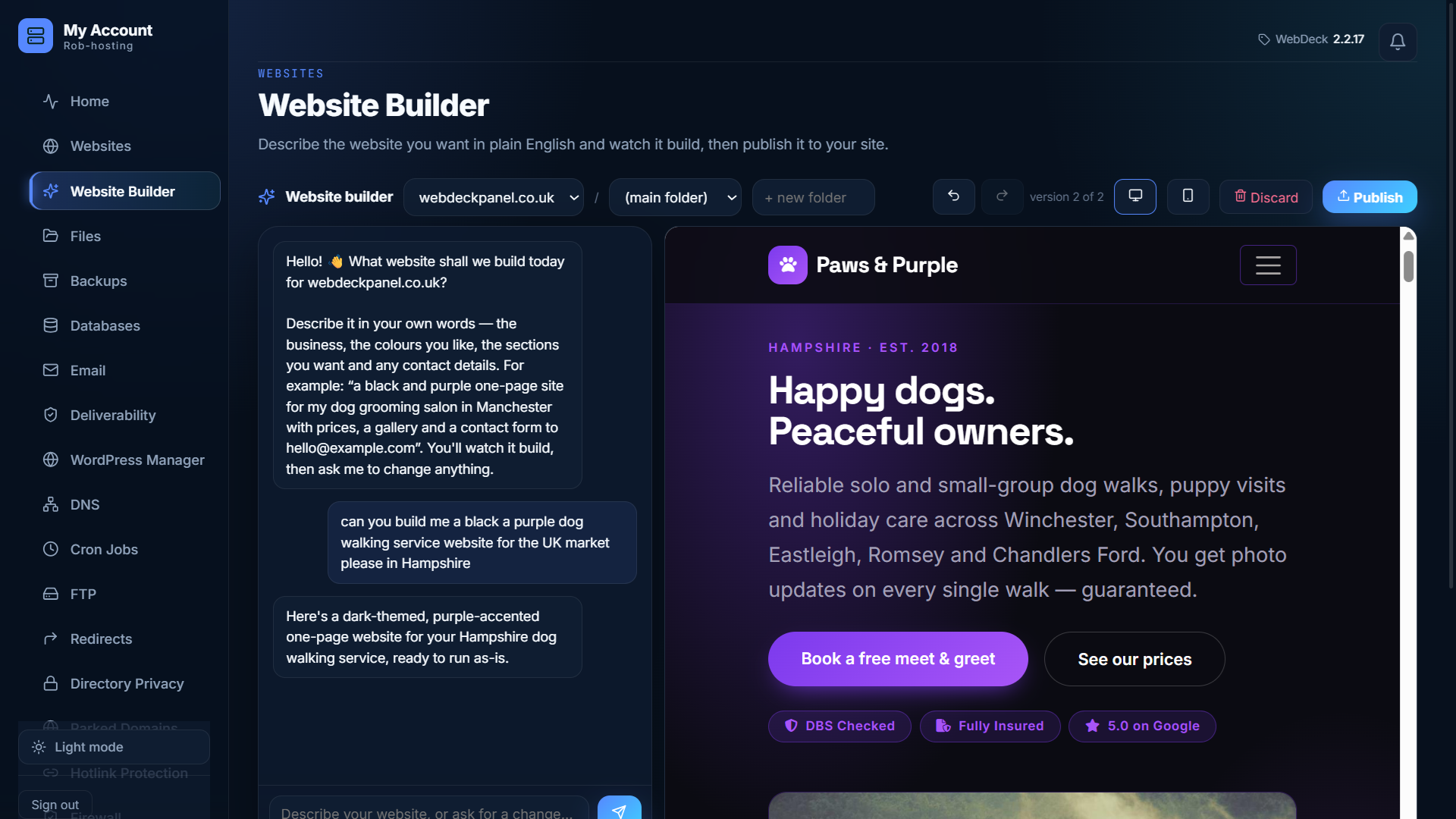
AI website builder New — 2.2.17
Describe the site you want and WebDeck builds it in front of you — a full, responsive page that appears live in a preview as it's generated. When it looks right, publish puts it live in one click.
- Build from a description — plain English in, a working page out
- Live preview — watch the page take shape as it's generated, not after
- Undo & redo — step back and forward through versions; the builder acknowledges each change
- Responsive by default — preview sits beside the chat on desktop, drops below it on a phone
- Full preview — open the site full size in its own window 2.2.19
- One-click publish — straight onto the site, no copy-paste
- Monthly AI allowances — you set how much each plan can use on your key; customers see what's left 2.2.19
- Streamed generation — long builds stream as they're produced and never hang
Resellers & white-label
Four roles, real quotas with overselling protection, and branding that cascades — your reseller's customers see your reseller's brand, never yours.
- Admin → master reseller → reseller → user
- Package types — a package's type creates the right kind of account automatically
- Packages — disk, bandwidth, sites, databases, email, with an Unlimited tickbox on any limit
- Plan features & AI allowances — tick what each plan includes; a reseller's AI allowance is a shared pool for all their customers
- Dedicated resource pools — CPU/RAM/process caps per plan that cascade to a reseller's customers' sites
- Overselling protection — can't allocate what you don't have
- White-label branding — name, logo, colours, favicon
- Branding cascades down the hierarchy automatically
- Resellers never see the server — or the isolation controls; only their own customers
- Suspend and unsuspend accounts
- WHMCS module 3.0 — sell all three levels automatically, with real suspensions, one-click sign-in and usage billing
Plans you control New — 2.2.19
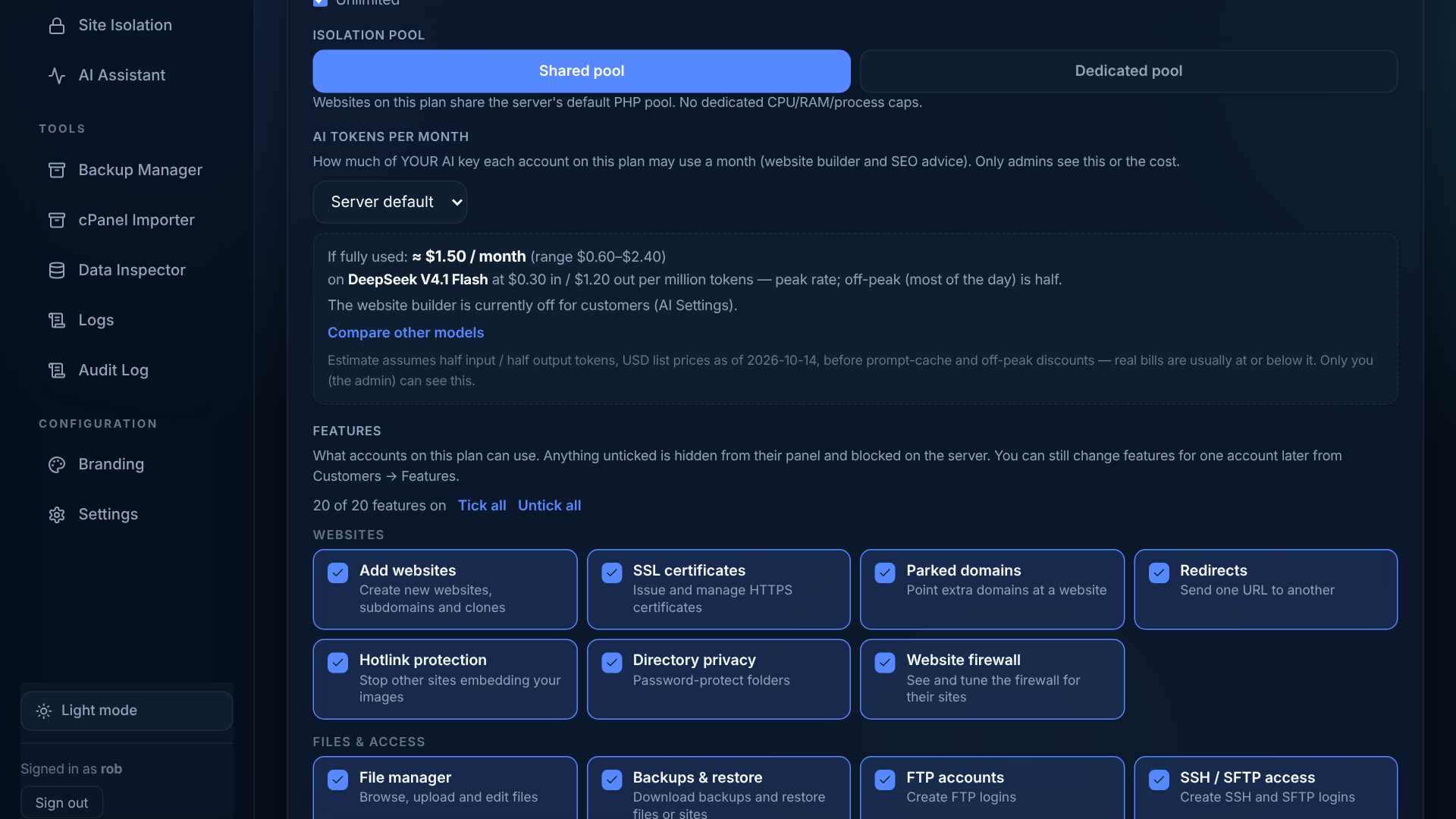
Decide exactly what each package includes — and how much AI it can use on your key, with the cost in front of you before you sell it.
- 20 features to tick or untick — WordPress manager, AI website builder, SEO tools, email, databases, SSH and more
- Enforced, not just hidden — anything switched off is refused by the server too
- Per-account overrides — change one customer's features without touching the plan
- Resellers stay inside their limits — they can only switch on what they have themselves
- Monthly AI token allowances — per package or per account: an amount, unlimited or none
- Cost estimates as you type — what an allowance costs on Claude, OpenAI or DeepSeek, visible only to you
- A hard ceiling — no account can spend past its allowance; customers see their own tokens used and left
WordPress staging, pushed to live New — 2.3.1
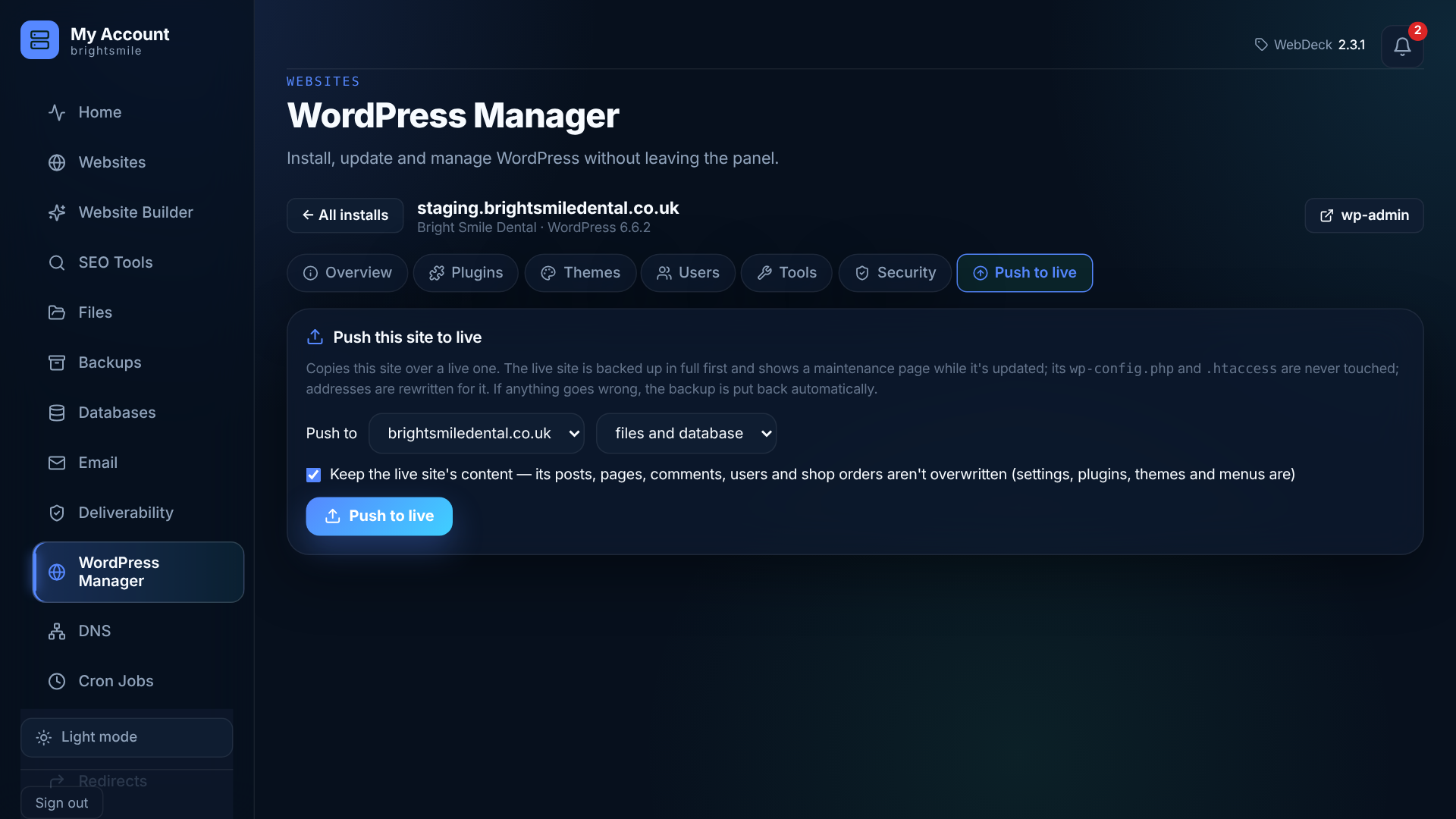
Clone a WordPress site to a staging subdomain, work on it in peace, then push it back to the live site in one go.
- One-click staging copy — files and database copied to a subdomain, with its own database, so it can never write to the live site by mistake
- Push files, the database or both — addresses are rewritten for the live site automatically
- Keep the live site's content — update settings, plugins and themes without losing new posts, pages, comments, users or shop orders
- Backed up first — the live site is backed up before the push and put back automatically if anything goes wrong
- Never touches wp-config.php — the live site keeps its own database settings and
.htaccess
WordPress manager
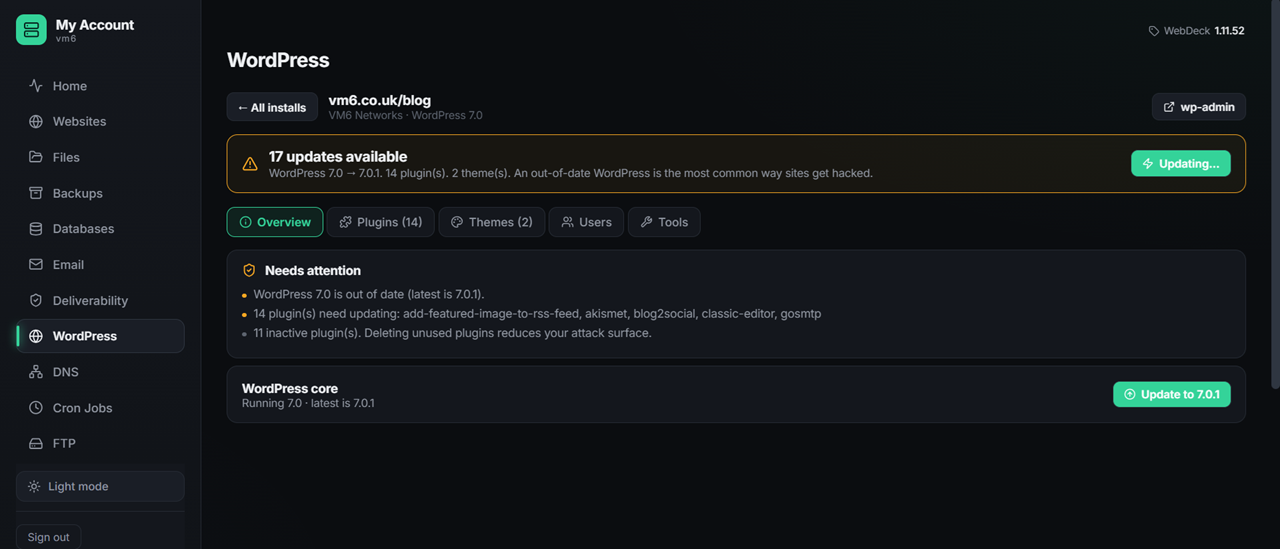
WebDeck finds every WordPress install on a site — even ones in subfolders that it didn't create — and tells you which ones need attention.
- Auto-detects WordPress anywhere in the document root
- Finds installs in subfolders, not just the root
- Version checking — spot the ones that are out of date
- Reads wp-config to link each install to its database
- One-click install with database and SSL ready
- WooCommerce variant — shop-ready in a single step
- Staging & push to live — with its own database, backed up first 2.3.1
- Security switches and a nightly check for known holes 2.3.1
- Update every site at once — one at a time, each backed up first 2.3.1
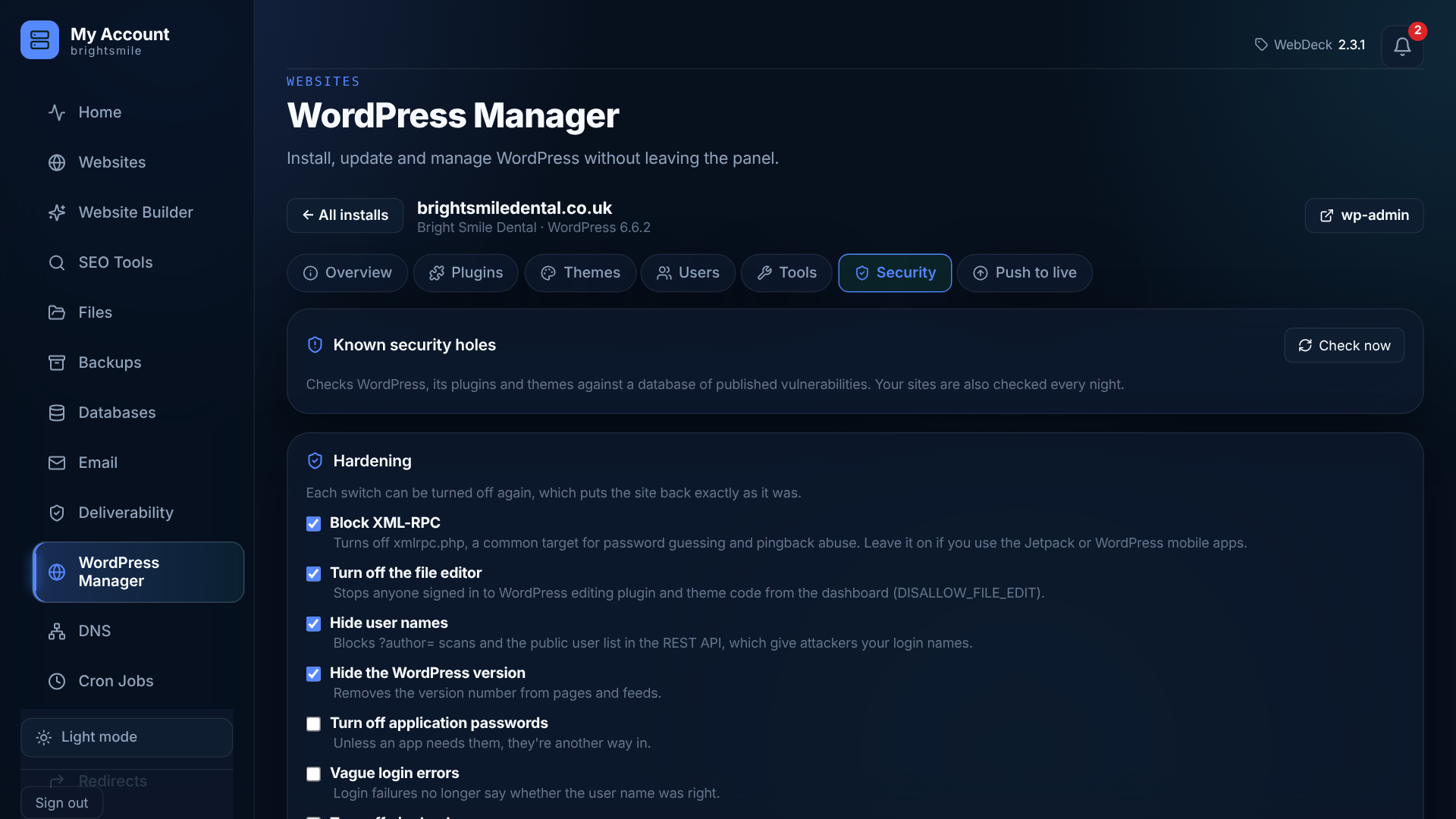
WordPress security, one switch at a time New — 2.3.1
Twelve one-click hardening options for every WordPress site, a nightly check for known holes, and one button to update everything.
- 12 hardening switches — block XML-RPC, hide user names, stop PHP running from uploads, turn off the file editor and more
- Exactly undoable — turning a switch off puts the site back as it was
- Known security holes — your host can switch on a nightly check against a database of published WordPress vulnerabilities; a red badge says which plugin or theme to update
- Update every site at once — WordPress, plugins and themes on all your sites, one at a time, each backed up first; the run stops at the first failure
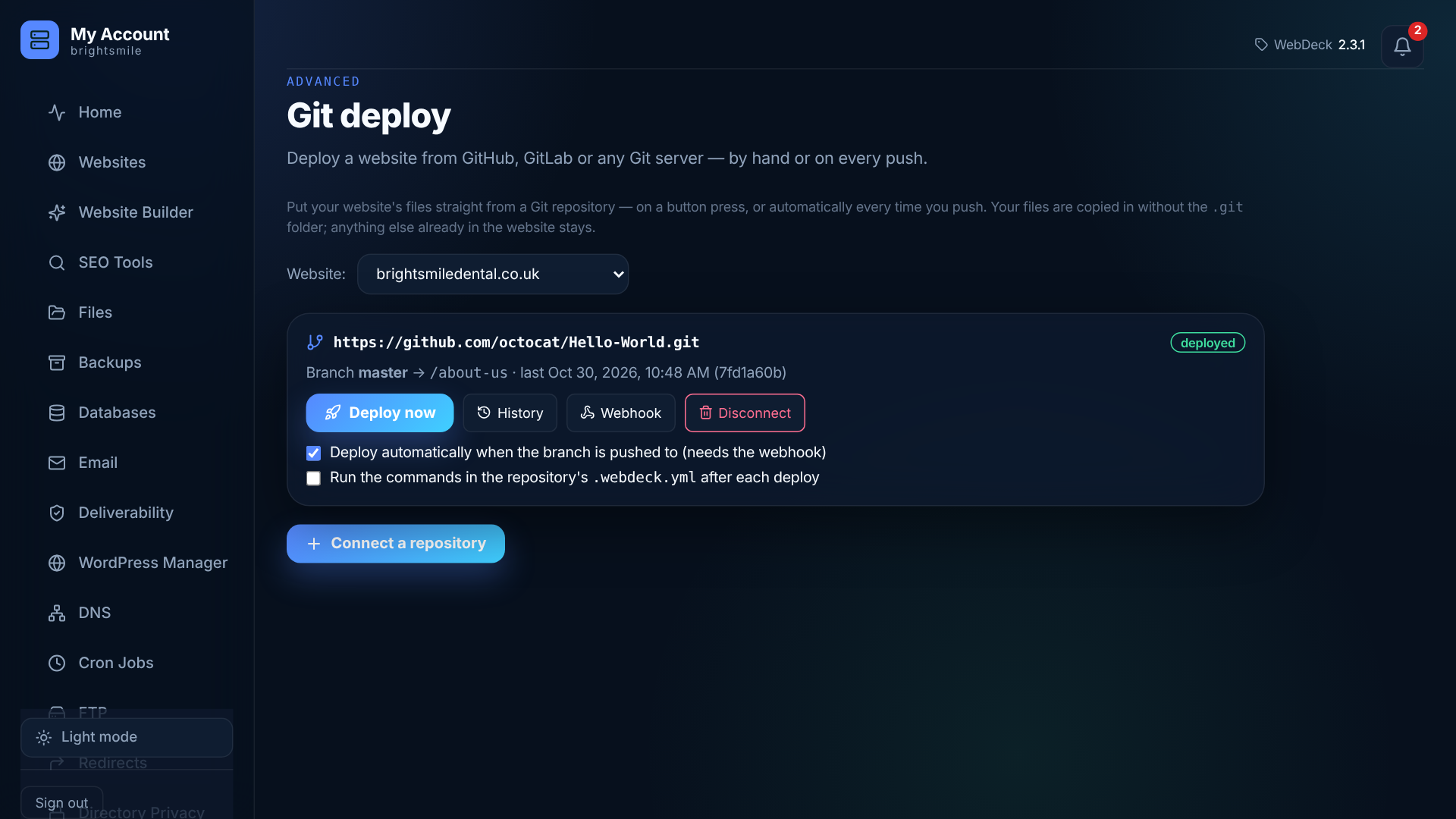
Deploy from Git New — 2.3.1
Connect a GitHub, GitLab, Bitbucket or other Git repository to a website, then deploy with one button — or automatically every time you push.
- One click or on every push — a webhook for GitHub or GitLab deploys the branch you choose
- Private repositories — each one gets its own read-only deploy key to add
- Only your files change — files you delete from the repository go on the next deploy; anything else in the website is left alone, and the
.gitfolder never goes live - Build steps — with SSH access on the plan, a
.webdeck.ymlcan run commands likecomposer install, as the website's own account, with time and memory limits - Deploy history — every deploy, with its log, for the last 20
- Safe by design — the site must run as its own account, and repositories on private networks are refused, so the panel can't be used to probe your network
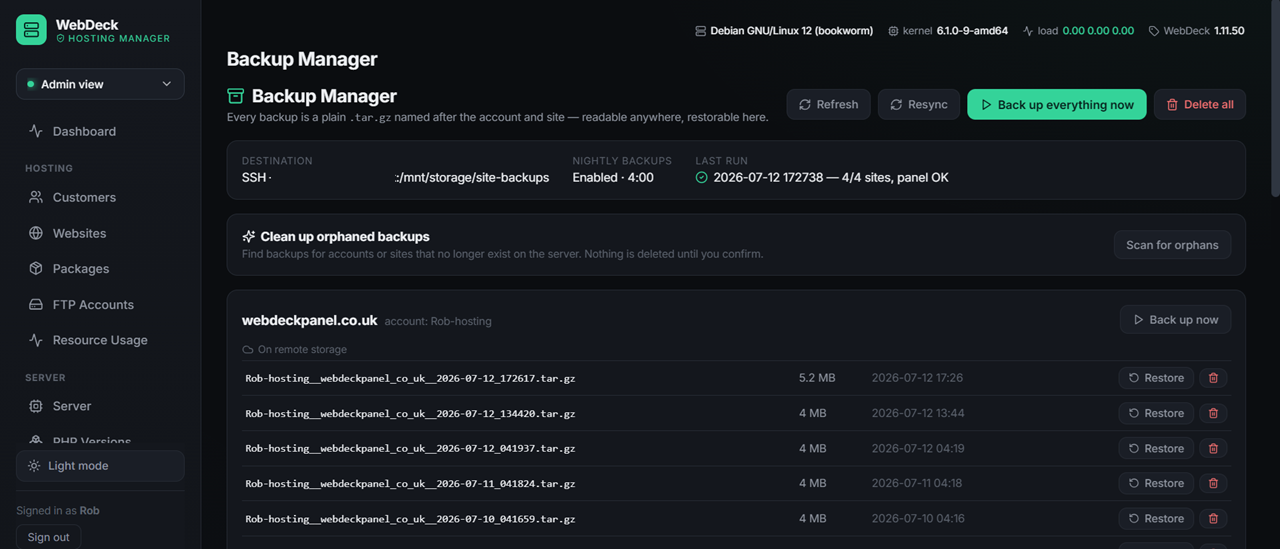
Backups & disaster recovery
Not "we tar your files up". WebDeck rebuilds an entire server onto bare metal — and tests its own backups to prove they'd actually work.
- Scheduled backups — daily, weekly, retention you choose
- Off-site — SFTP and rclone (S3, Backblaze B2, Drive and more)
- Deduplicated and encrypted — powered by restic
- Full server restore — rebuild a dead server from scratch
- Per-site restore — roll one site back, leave the rest alone
- Site snapshots — take one before you do something risky
- Customer self-restore — scoped to their own domains
- Backup self-test — an untested backup isn't a backup
- Customer backup schedules — daily or weekly, on top of yours 2.3.1
- Restore as of a date, and bring back a deleted account 2.3.1
- Encrypted panel backups — with a passphrase only you hold 2.3.1
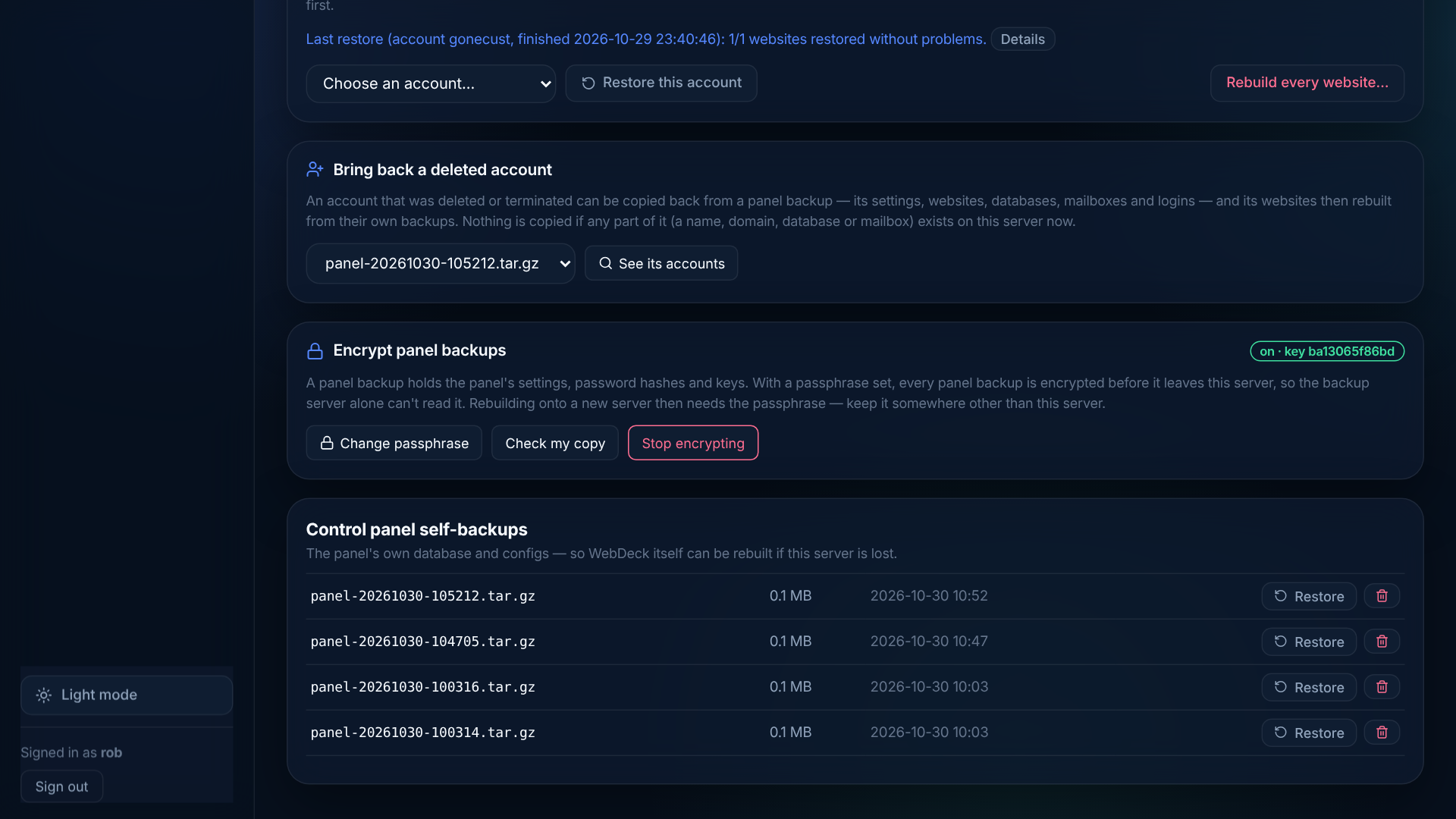
Bring back what was deleted New — 2.3.1
Deleted an account by mistake? Bring it back from a panel backup, websites and all. Or put a website back as it was on a chosen day.
- Bring back a deleted account — settings, websites, databases, mailboxes, logins and DNS, then each website rebuilt from its own backups
- Never overwrites — nothing is copied if any part of the account exists on the server now
- Restore as of a date — pick a day and each site comes back from the newest backup on or before it
- Encrypted panel backups — set a passphrase and every panel backup is encrypted before it leaves the server, so the backup storage alone can't read it
Server management & self-healing
The panel knows how the server is doing — and fixes most problems before you find out about them.
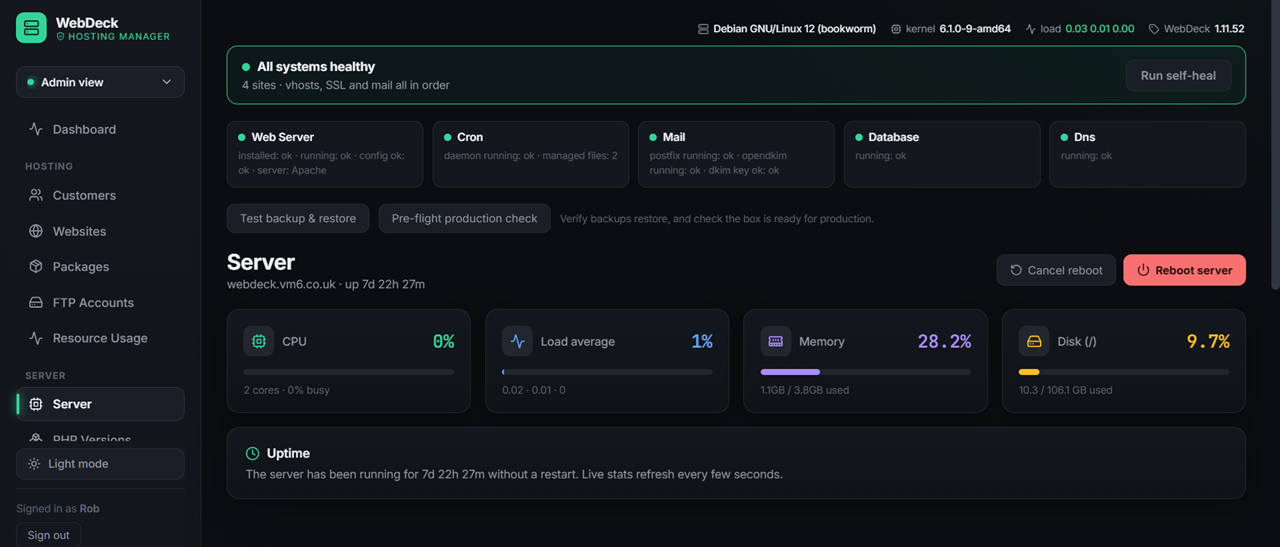
- Live CPU, memory, disk and load
- Self-healing reconcile — rebuilds vhosts, renews certs, restarts services
- Self-healing permissions 2.2.18 — web server access, wp-config, certificate keys and the panel’s own secrets kept correct automatically
- Email notifications — service down, backups, low disk, security and more, with per-alert toggles
- Bandwidth and full-mailbox alerts to customers and resellers 2.3.0
- Notification bell in the header — the same alerts, in the panel, whether or not email is set up
- Health checks — vhosts, certificates, mail delivery
- Service control — start, stop, restart from the panel
- Resource usage per account and per site
- Disk usage breakdown — find what's eating the disk
- Data inspector — look inside the panel's own database
- Self-updating — with automatic rollback if an update fails, or is interrupted part-way
Security WAF — 2.2.9
Sensible defaults, not a checkbox exercise.
- Per-site isolation 2.2.13 — each website runs as its own system user, so code on one site can never read or change another's files. A real OS-level boundary between accounts, not just a software check; apps with data outside the web folder (WHMCS, etc.) are handled automatically
- Web Application Firewall — ModSecurity + the OWASP Core Rule Set, catching SQL injection, XSS, path traversal and scanners. Installs in detection-only; plain-English protection levels; blocks nothing until you choose to. Apache and nginx. New in 2.2.9.
- Per-customer firewall view — each account sees the detections on their own domains, and can set detect or block per site
- Hotlink protection — stop other sites embedding your images and using your bandwidth, with a CDN allow-list
- On-demand malware scanning — ClamAV, scan any site's files from the panel
- Hide web server version — stop Apache/nginx advertising their exact version to scanners
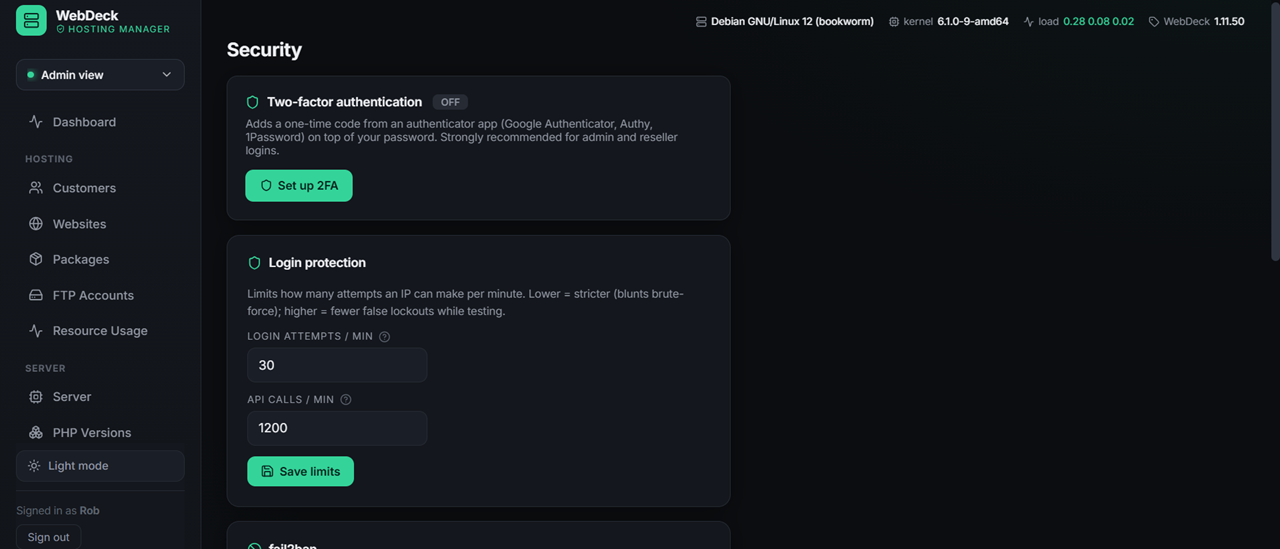
- Two-factor authentication (TOTP) on panel logins, with replay protection
- Keep me signed in — an optional 30-day sign-in; you choose the length, or switch it off 2.3.0
- Locked-down panel pages — only the panel's own code can run, and it won't load inside another site 2.3.0
- fail2ban — brute-force protection, managed from the panel
- Firewall management from the interface
- Login rate limiting — configurable per minute
- API keys — scoped, and lockable to a single IP
- Directory privacy — password-protect any folder
- SSH key management
- Audit log — every action, with who and when
Migrating from cPanel
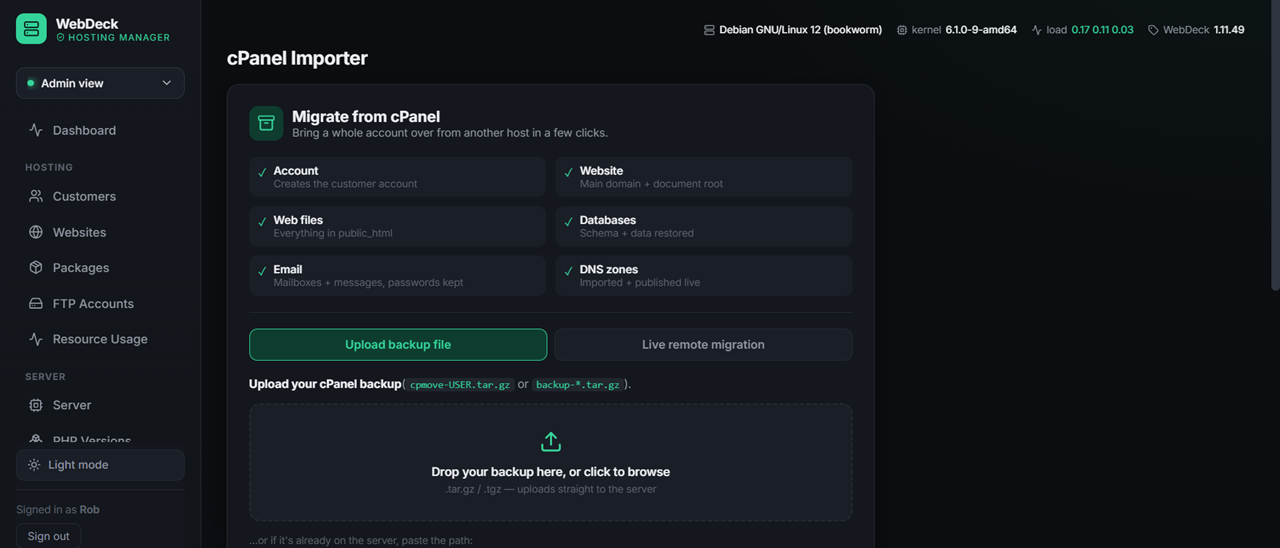
Point the importer at a cPanel backup and it recreates the account properly — not a half-import that leaves you fixing things for a week.
- Reads standard cPanel archives (cpmove / full backups)
- Websites and document roots recreated
- Databases and users restored with privileges
- Email accounts and their mail
- DNS records imported
- Bulk import — move a whole server, not one account at a time
- Remote pull — fetch backups straight from the old server
- Preflight check — see what will happen before it happens
57 one-click apps
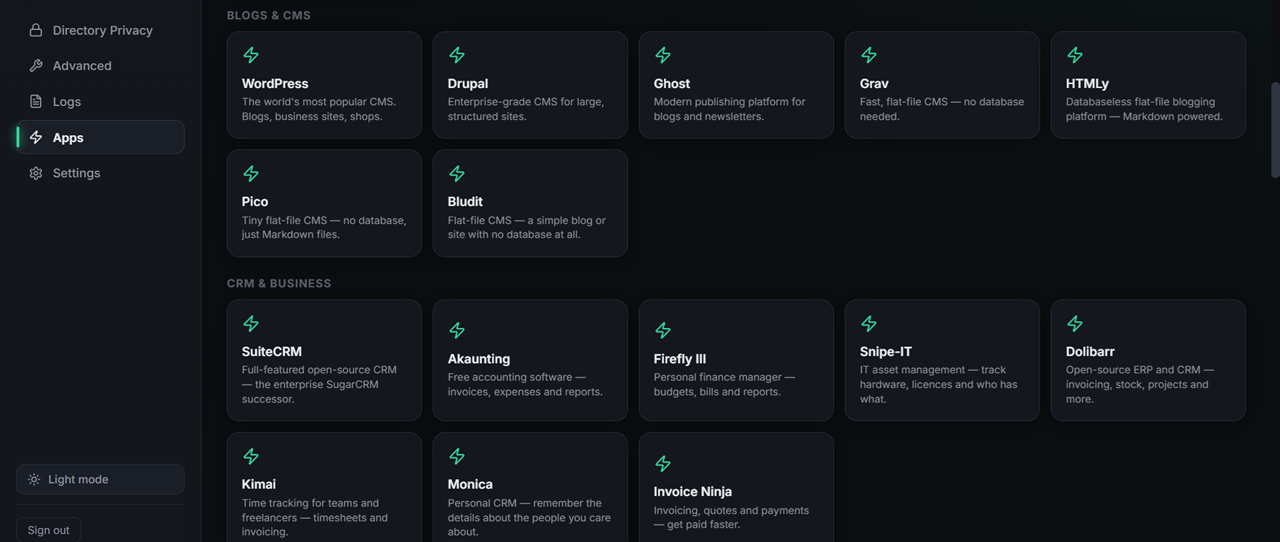
Not a token WordPress button. Fifty-seven applications, each installed properly — database created, permissions set, config written, SSL live from the first request. Apps that need Composer get their dependencies installed too, so they actually run.
- WordPress — plus a WooCommerce shop variant
- osTicket, GLPI — helpdesk and IT asset management
- SuiteCRM, Dolibarr, Invoice Ninja, Akaunting — CRM and billing
- Moodle — a full learning management system
- Nextcloud — private file sync and share
- Magento, PrestaShop, OpenCart — e-commerce
- Snipe-IT, Kimai, HumHub, Monica — Composer handled for you
- Customers install them themselves — no ticket for you
- See all 57 apps →
PHP, done properly
Multiple versions side by side, and — since 2.2.0 — a complete PHP environment per website: each site's version, modules and settings are its own, isolated from every other site. Works on every OS and every web stack, not just Debian.
- Multiple PHP versions installed together
- Per-site version — legacy app on 7.4, new one on 8.3
- Per-site modules — each website toggles its own, affecting no one else
- Per-site PHP settings — memory, upload size, execution time
- ionCube loader — one click (WHMCS and friends)
- OPcache and the performance modules
- FPM pool tuning per site — and site owners can tune their own PHP workers 2.3.0
- Self-healing — repairs broken module config automatically
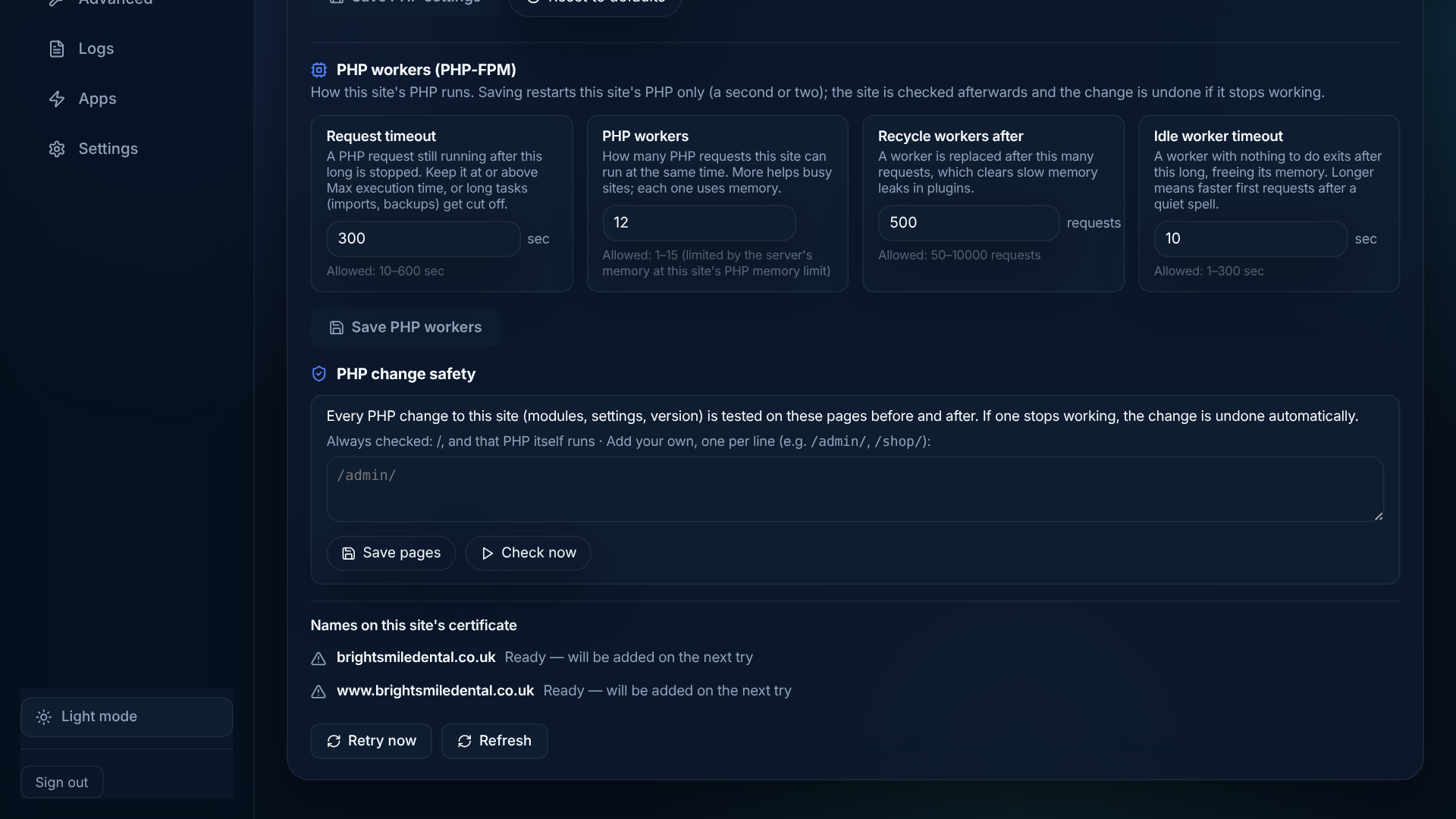
PHP workers, in your customers' hands New — 2.3.0
Site owners tune their own PHP-FPM — how long a request may run and how many run at once — within the limits you set and the resources their plan allows.
- Request timeout — up to 20 minutes, for imports, backups and long reports; the web server waits as long
- Workers — how many requests the site handles at the same time
- Recycling and idle timeout — clear slow memory leaks and free memory when it's quiet
- Your ceilings — set once under Settings, or switch owner editing off
- Can't overload the server — workers are capped by the site's RAM and process allowance
- Undone if it breaks — the site is checked after every change and rolled back if it stops working
Email that lands in the inbox
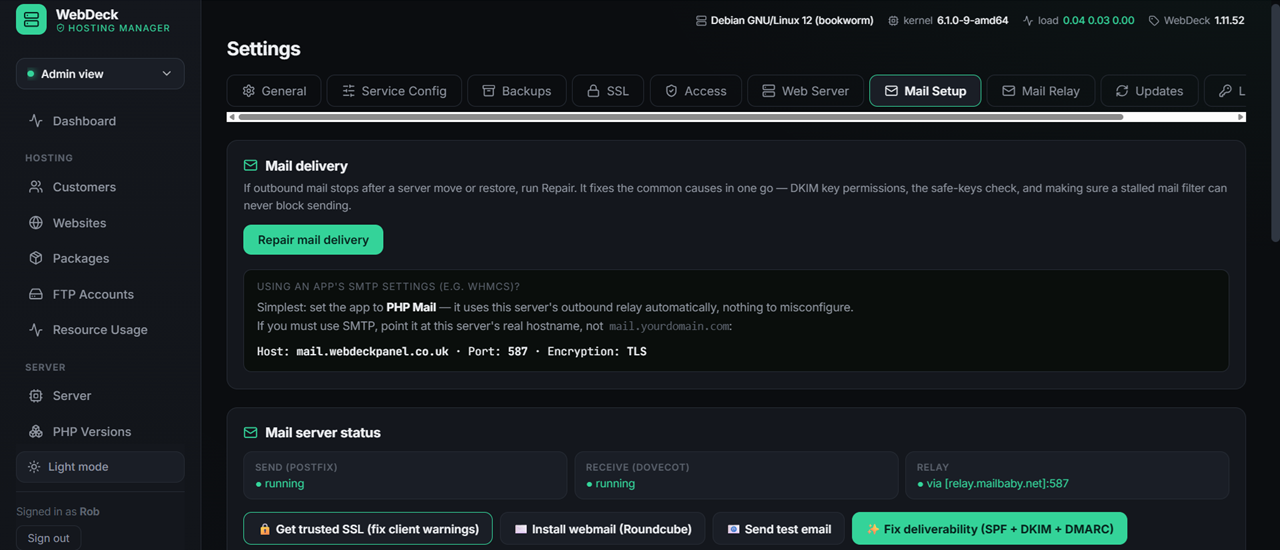
A full mail server — Postfix and Dovecot — with the deliverability records set up for you. Most panels leave DKIM as homework. WebDeck does it on day one, then checks its own work.
- Mailboxes, aliases, forwarders, catch-alls — with real mailbox sizes
- Spam filtering, out-of-office replies and mail rules 2.3.0
- DKIM signing — keys generated, DNS published automatically
- SPF and DMARC records created for you
- Deliverability checker — tells you what's wrong before Gmail does
- Auto-deliverability — fixes common problems on its own
- Mail self-test — proves the whole chain works, end to end
- Webmail built in — customers log in from the panel
- Autoconfig — Outlook and Thunderbird set themselves up
- SMTP relay support, and TLS hardening in one click
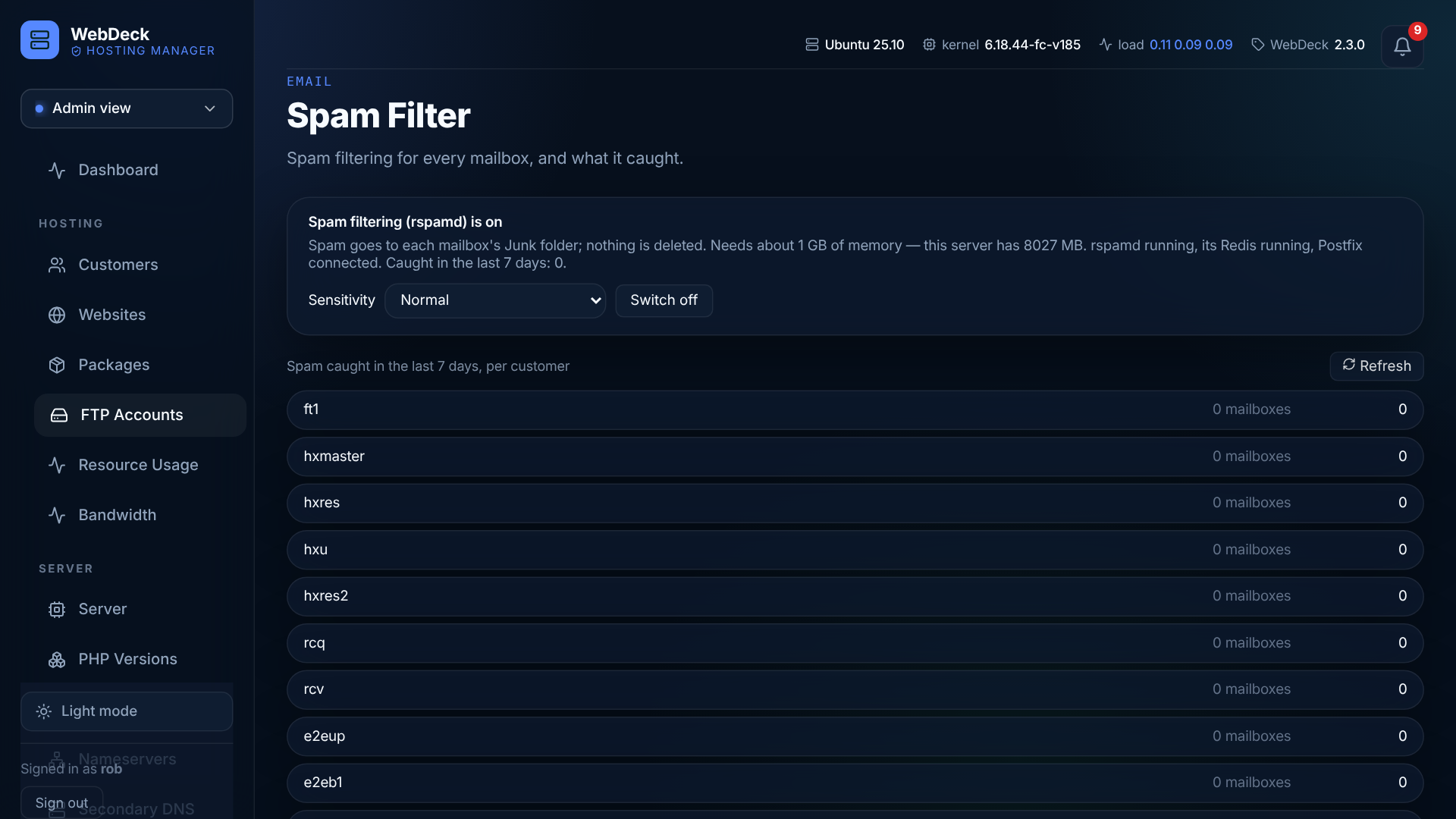
Spam filtering New — 2.3.0
A modern spam filter (rspamd) that you switch on with one click. Spam lands in Junk, nothing is deleted, and each mailbox can be tuned on its own.
- One switch for the server — plus a server-wide sensitivity: low, normal or high
- Per-mailbox control — turn it off, change the sensitivity, or always let certain senders through
- Learns as you go — moving a message into or out of Junk teaches the filter
- No DNS changes — DKIM signing carries on as before, and mail isn't delayed by greylisting
- Never blocks mail if it stops — mail keeps flowing even if the filter is down
- Spam caught per customer — for you and your resellers, over the last 7 days
Out of office & mail rules New — 2.3.0
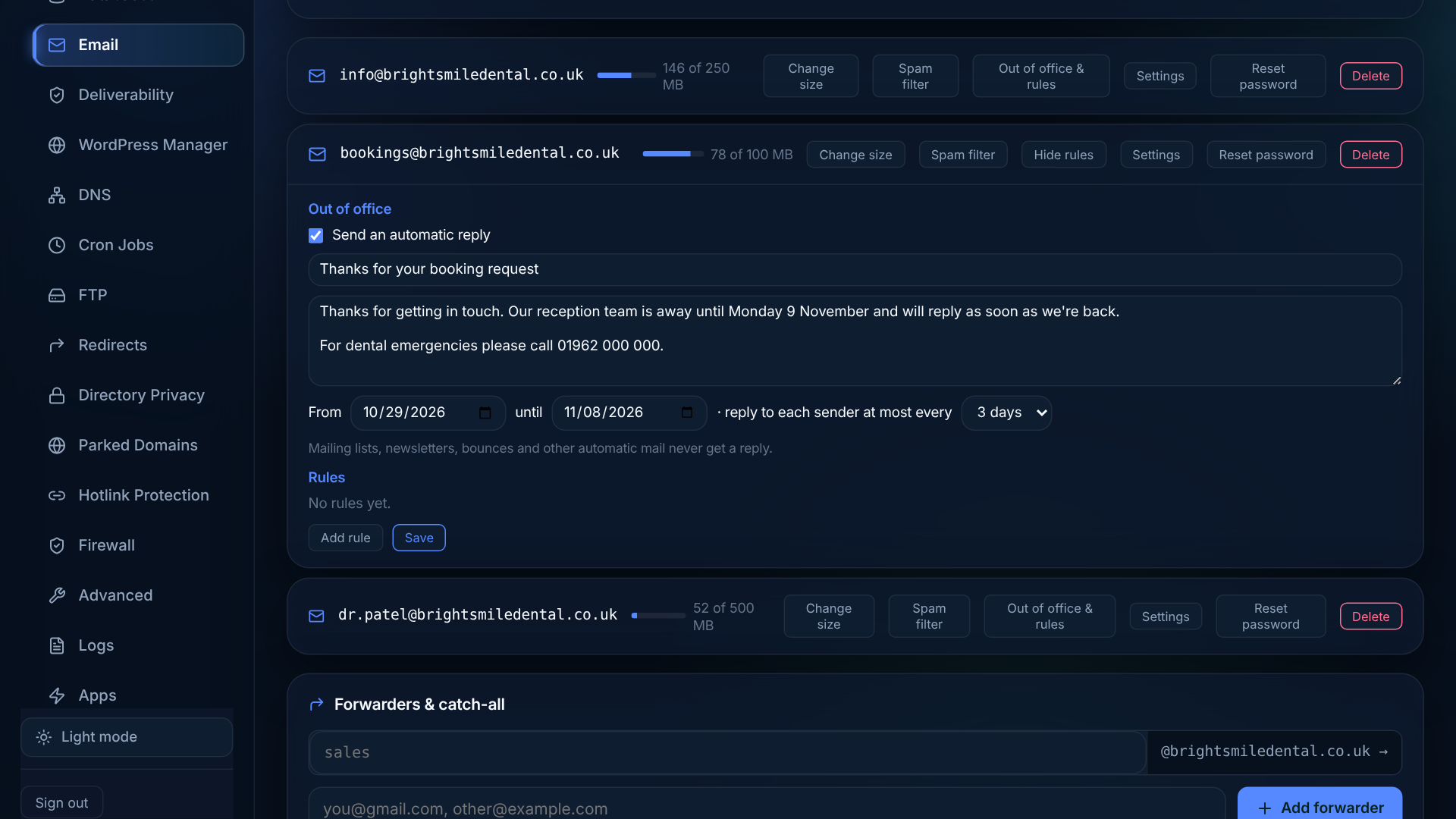
Every mailbox gets automatic replies and simple rules, set up in plain English — no scripts to write.
- Out-of-office replies — with start and end dates, sent once per sender, never to mailing lists or newsletters
- Mail rules — if From, To or Subject contains something, move it to a folder, forward it or delete it
- Forward safely — forwarded mail is sent from the mailbox's own address, so it passes SPF
- Works in webmail too — Roundcube's Filters screen shows and edits the same rules
- Limits per plan — you set how many rules each mailbox may have
- Built safely — the panel writes the filter itself and checks it before it goes live
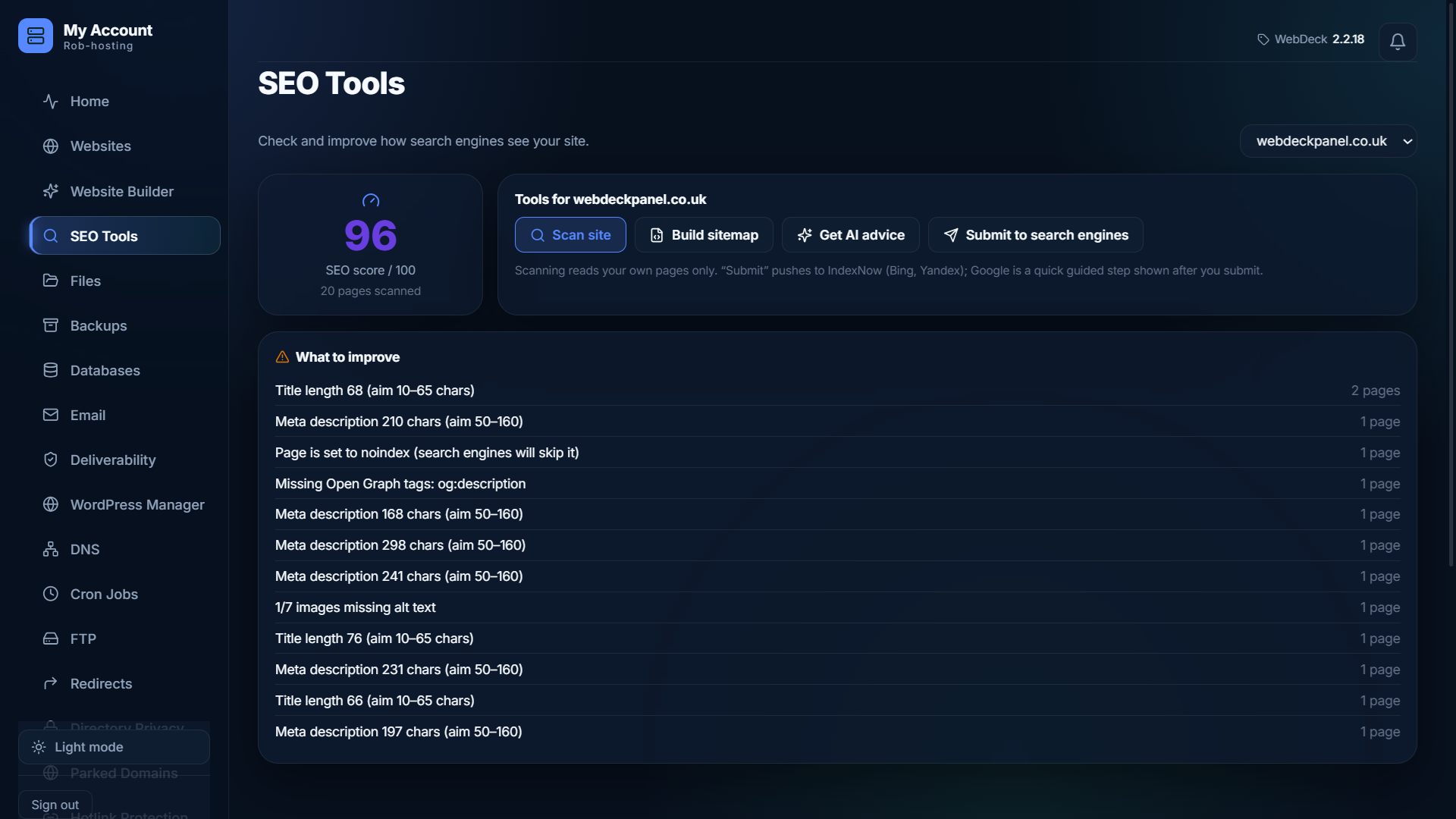
SEO tools New — 2.2.18
A search-engine check-up for every website, right in the customer panel — a score, a plain list of what to fix, and a quick way to get listed.
- SEO score out of 100 — see at a glance how a site is doing
- A plain list of what to fix — titles, descriptions, headings, image alt text, mobile, sharing previews
- One-click sitemap —
sitemap.xmlbuilt from the site’s pages - Submit to search engines — instant IndexNow push to Bing, Yandex and others
- Google, done honestly — step-by-step Search Console setup, not a fake “submitted” button
- AI advice — the results turned into a prioritised to-do list in plain English (optional)
- Private by design — reads only the site’s own files, never fetches from the internet
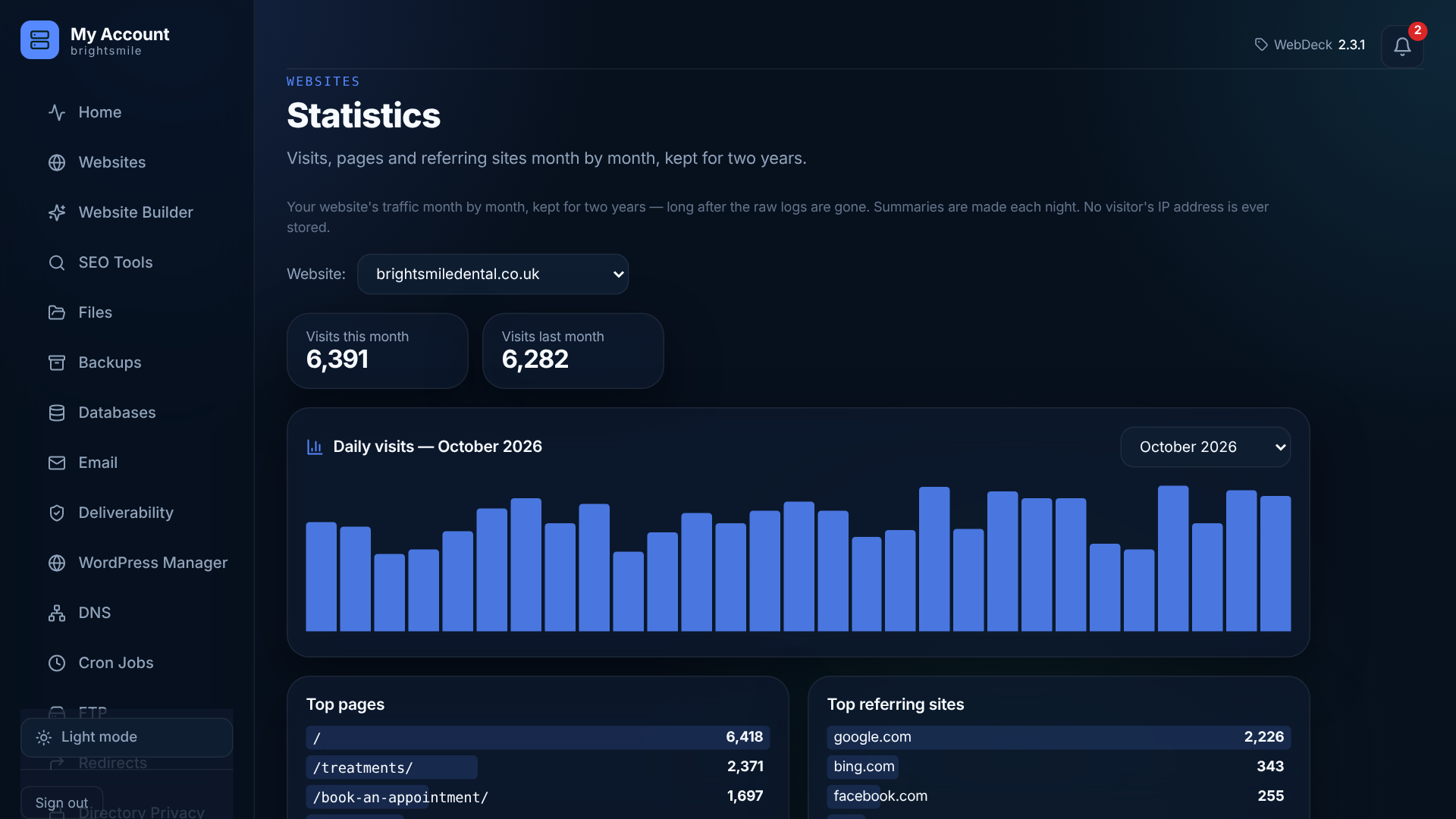
Monthly statistics, kept for two years New — 2.3.1
Visits, pages, referring sites and errors for every website, by day and by month — long after the raw logs have rotated away.
- Two years of history — a small summary is saved every night from the server's own logs
- Top pages and referrers — what people read and where they came from
- Spot problems — 404s and server errors, day by day
- No tracking script — nothing is added to the site, and nothing is sent anywhere
- Private by design — no IP addresses or browser details are kept, and query strings are dropped
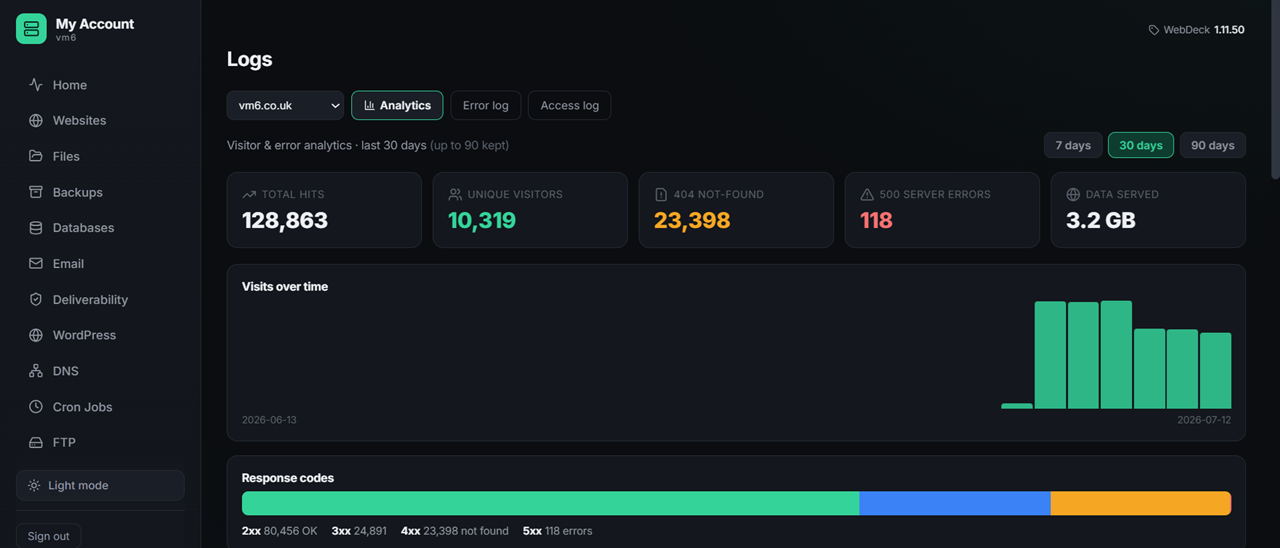
Website analytics
Built from the server's own access logs — so it works on every site with no tracking script, no third-party JavaScript, and nothing added to the page.
- Visits and hits over time
- Top pages — what people actually read
- Referrers — where the traffic came from
- Status codes — spot 404s and 500s before customers report them
- No tracking scripts — nothing added to the site
- No third parties — the data never leaves the server
- Privacy-friendly by design, not as an afterthought
- Monthly statistics — kept for two years, no IP addresses stored 2.3.1
- Or install Matomo in one click if they want more
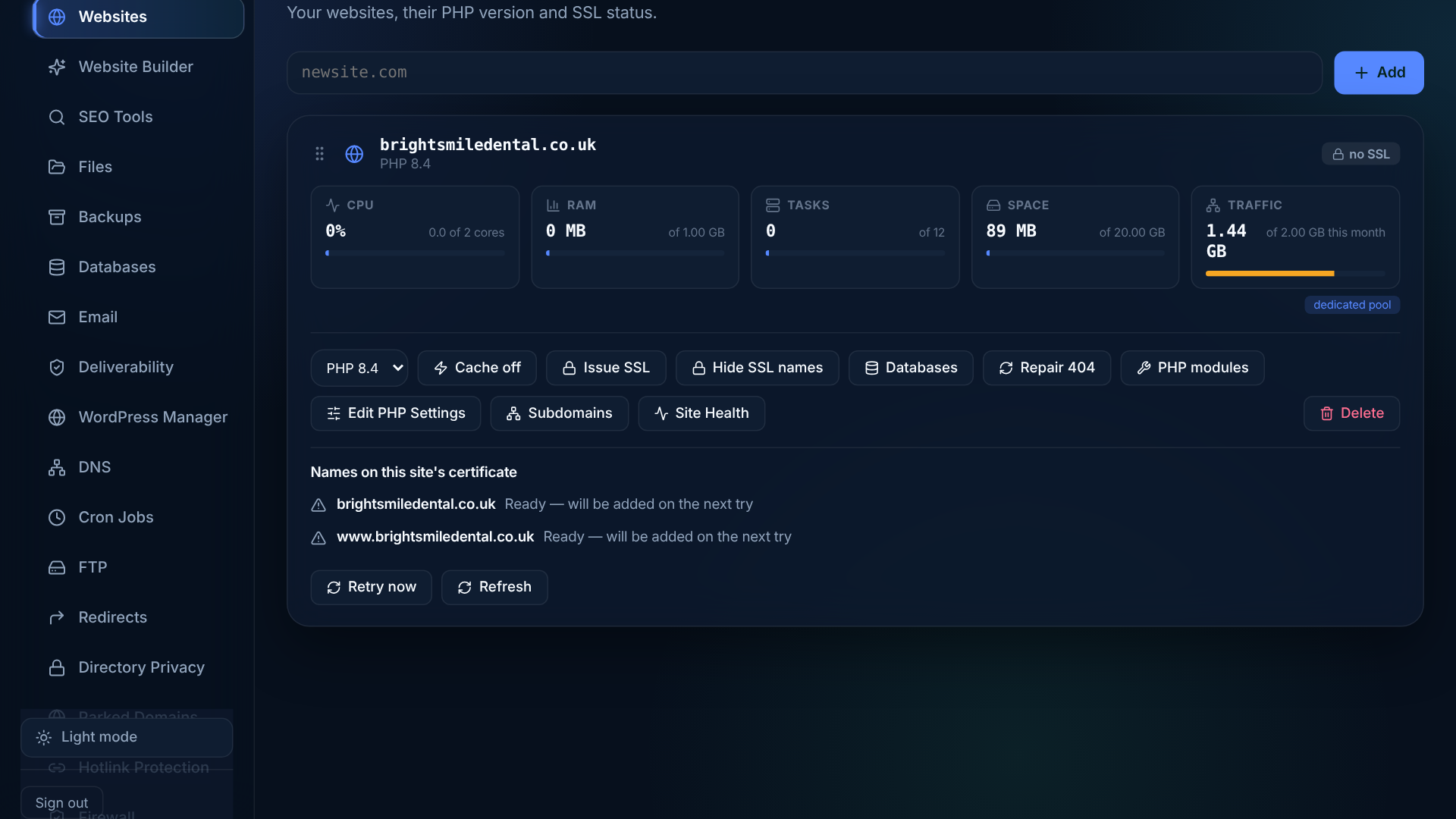
AutoSSL that checks first New — 2.3.0
Every name is checked before Let's Encrypt is asked, so a domain that isn't pointed here yet doesn't hold up the rest — or burn through Let's Encrypt's limits.
- SSL names list — see each name on a certificate and exactly what it's waiting for
- Works behind NAT and Cloudflare — names are proved the same way Let's Encrypt checks them
- Retries by itself — after 1 hour, 6 hours, a day, then daily for 30 days
- Retry now — for when you've just fixed the DNS
- Never shrinks a working certificate — because of a temporary DNS hiccup
Trusted HTTPS from minute one
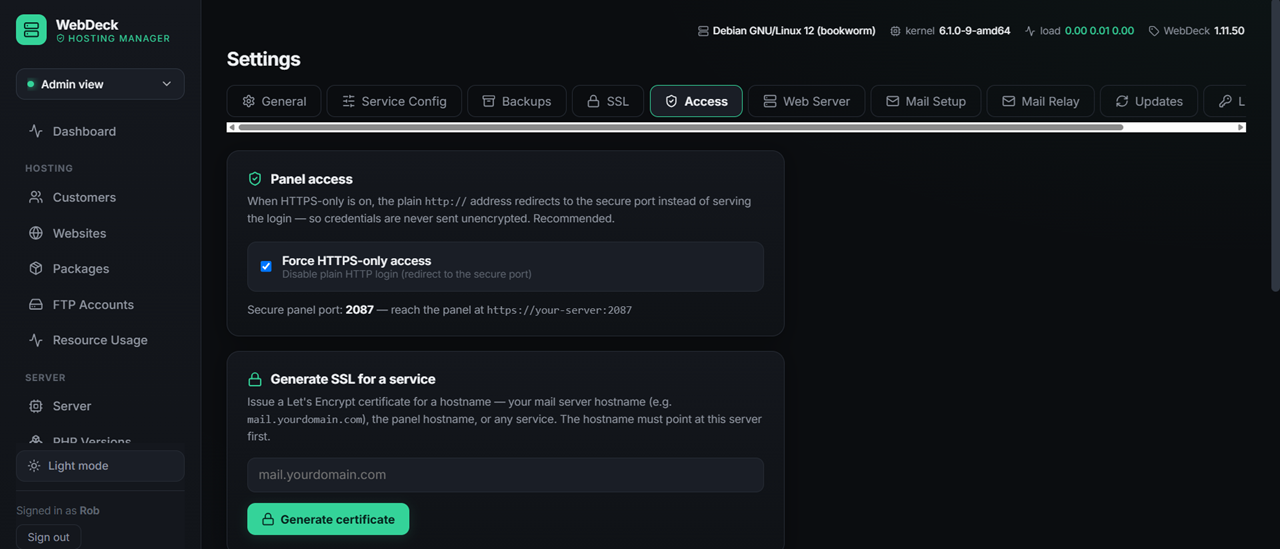
The bit every other panel gets wrong. A fresh WebDeck install gets a free hostname with a browser-trusted certificate — so the panel has a padlock before you've pointed a single domain at the box.
- Free hostname —
srv-a1b2c3.wd-server.co.uk, on install - Trusted certificate — fetched, installed and renewed for you
- No browser warnings on a brand-new server
- Let's Encrypt for customer sites — automatic issue and renewal
- Multi-domain certificates — the domain,
wwwand parked domains on one - AutoSSL checks every name first, and shows what each one is waiting for 2.3.0
- Fail-safe — if anything's unreachable, the panel keeps working
Secondary DNS cluster New in 2.2.5
One nameserver is a single point of failure. Add a second machine and WebDeck puts a full copy of every zone on it, so your customers' DNS keeps answering even if the main server is offline. You run one command on the new box — it installs PowerDNS, configures itself as a secondary and registers back with the panel on its own.
- One command to enrol — no SSH keys or root credentials leave the panel
- Every zone transferred automatically over AXFR, and kept in step
- NS records updated for you — once a secondary is confirmed serving, it's added to your zones' NS records so domains actually use it
- As many secondaries as you like — there's no cap
- Live health per server — zones in sync, PowerDNS version, OS, last seen
- Safe by design — a single-use token that expires, and guards that refuse to bulk-delete zones if the primary ever looks wrong
- Retire a nameserver safely — disable one only once a healthy secondary exists, never leaving you below two
- Debian, Ubuntu, AlmaLinux, Rocky and RHEL — the right PowerDNS setup for each
Authoritative DNS
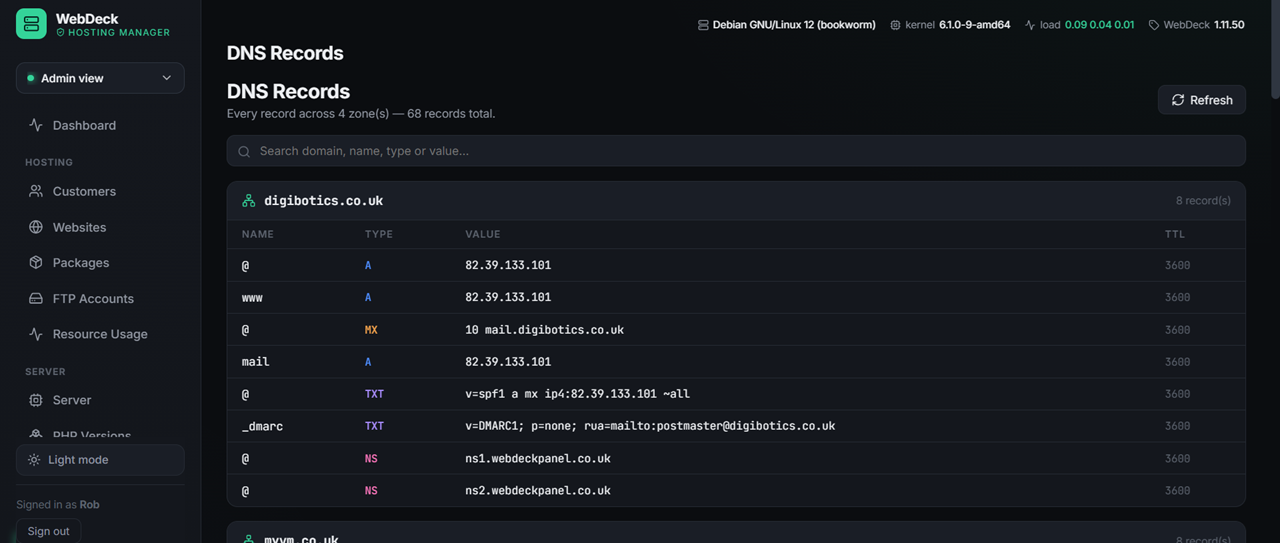
Run your own nameservers with PowerDNS. Zones are created automatically when you add a site, and WebDeck watches them to make sure they stay healthy.
- Your own nameservers — ns1/ns2 on your domain
- Automatic zone creation when a site is added
- Full record editor — A, AAAA, CNAME, MX, TXT, SRV, CAA
- DNS templates — apply a standard record set in one click
- Secondary nameservers — a full DNS cluster, set up remotely from the panel
- DNS health monitoring — spot a nameserver drifting out of sync
- Mail records published for you — MX, SPF, DKIM, DMARC
Branding & white-label
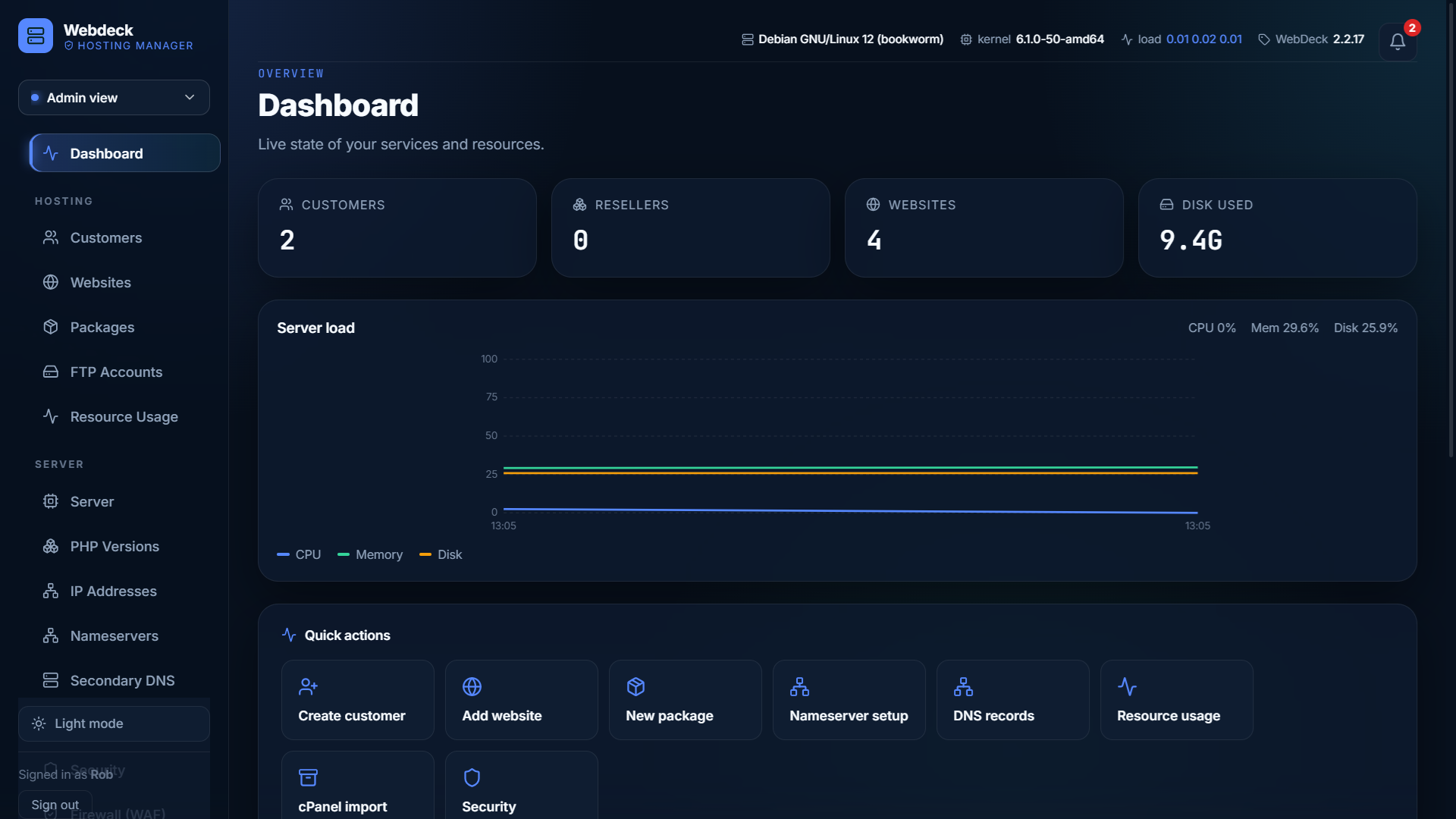
Make WebDeck yours. Your name, your logo, your colours — customers never see ours.
- Your brand name replaces WebDeck throughout the panel
- Your logo and favicon
- Your colours — match the panel to your own site
- Three brand colours 2.2.13 — accent, secondary and a positive/success colour, used across every theme
- Three interface themes 2.2.13 — Aurora (modern glass, the default), Classic and Console; light and dark, with dark mode the default on new installs
- Cascades to resellers — their customers see their brand, not yours
- Applies to the whole panel, not just a login page
- Free — white-labelling isn't a paid tier
Backups your customers schedule New — 2.3.1
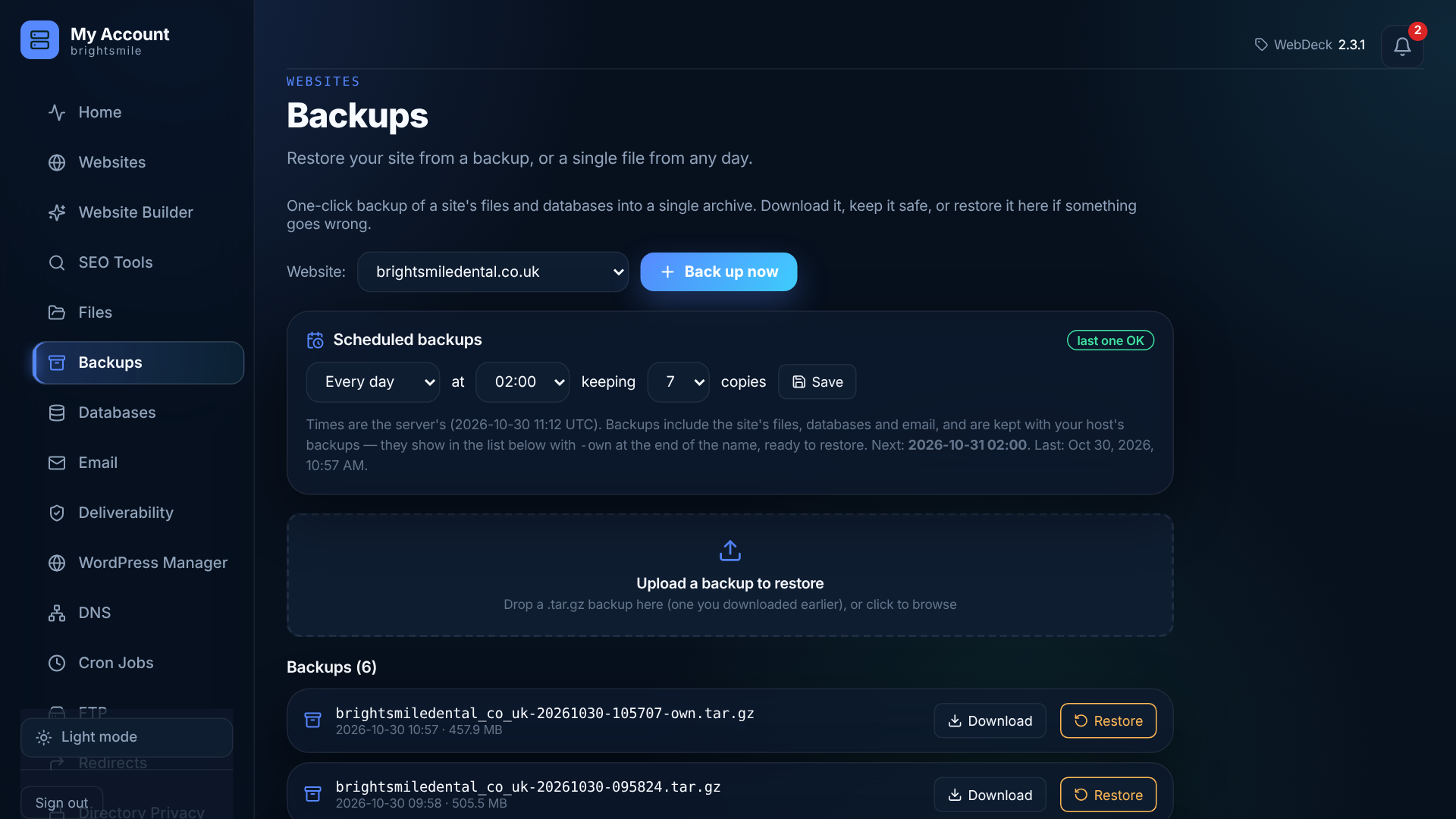
Customers can set their own daily or weekly backups for each website, at the time they choose — on top of your nightly backups, never instead of them.
- Daily or weekly, at a set hour — and how many copies to keep, up to the plan's limit
- Kept separately — their own copies never push your nightly backups out, or the other way round
- One at a time — scheduled backups queue behind each other and your nightly run, so the server isn't swamped
- Told if it fails — the customer gets an alert, and it's retried later that day
- You set the ceiling — a server-wide limit, and a Scheduled backup copies limit per plan
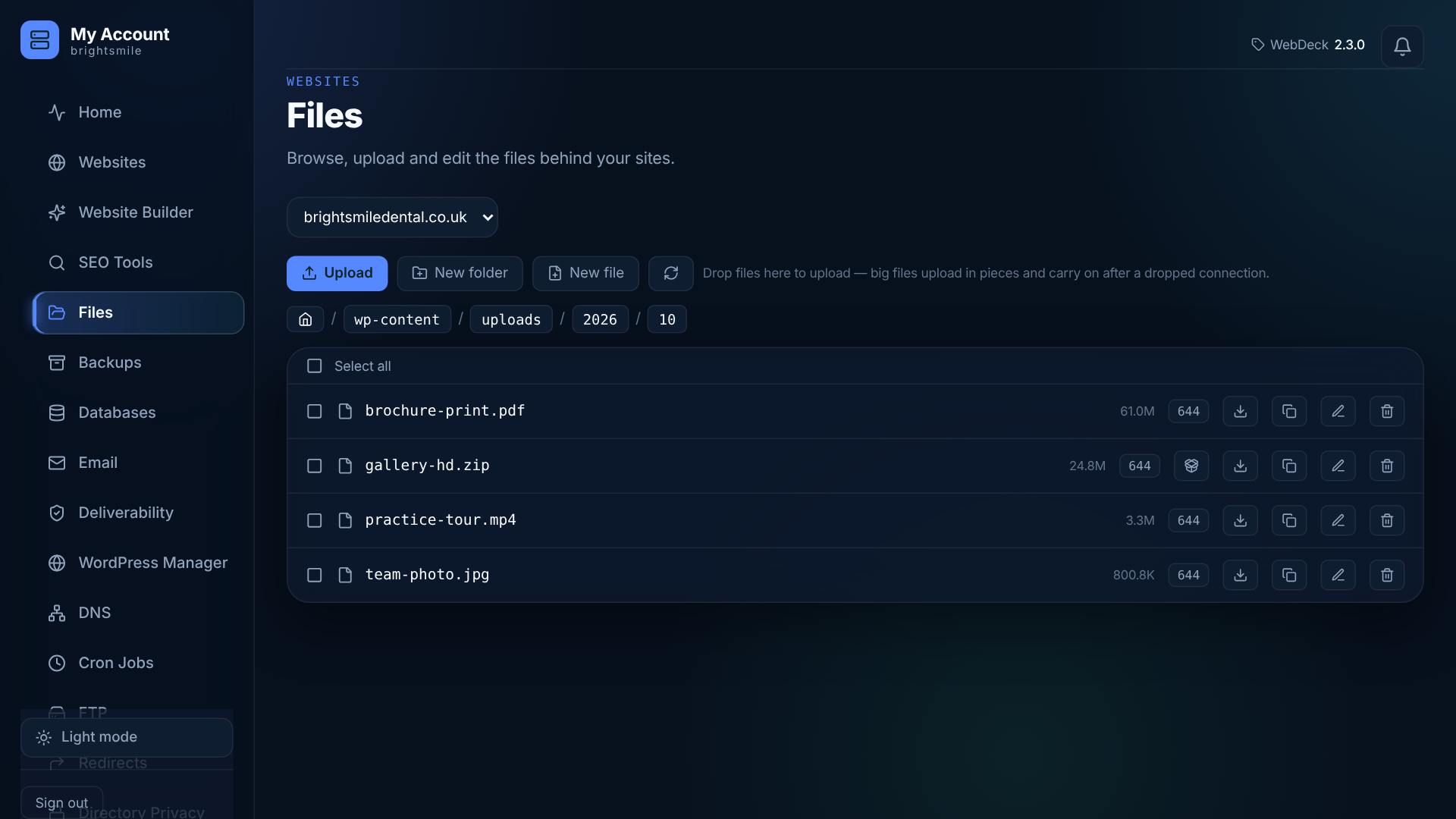
File manager Rebuilt — 2.3.0
A real file manager in the browser. Fix a config typo, upload a logo, check permissions — without opening a terminal or making your customer install FileZilla.
- Browse the whole site with a proper tree view
- Edit files in the browser — syntax-friendly, saves instantly
- Uploads up to 4 GB — drag files straight in; a dropped connection picks up where it stopped 2.3.0
- Downloads of any size, streamed straight from disk
- Select several at once — delete, move, copy or change permissions in one go 2.3.0
- Drag onto a folder to move, and copy files and folders 2.3.0
- Zip and unzip — make .zip or .tar.gz, unpack .zip and .tar archives in the browser 2.3.0
- Create folders, rename, move, delete
- Change permissions (chmod) from the interface
- Scoped safely — a customer can't escape their own directory
- FTP accounts too (always encrypted: FTPS or SFTP), if they'd rather use a client
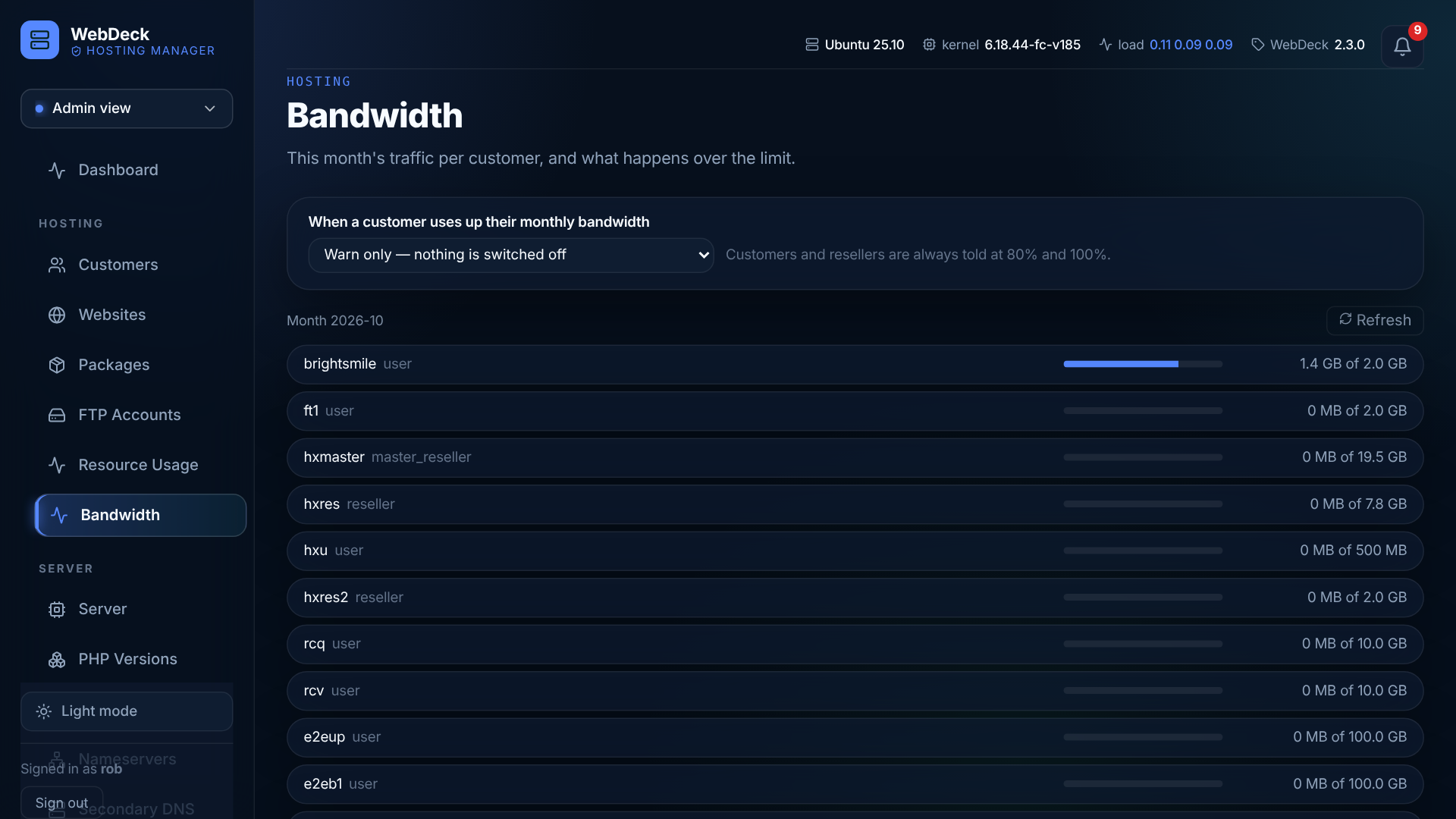
Bandwidth metering New — 2.3.0
Real monthly web traffic, per site and per account, counted by the web server itself — and your choice of what happens when someone runs out.
- This month at a glance — customers see their use against their allowance on the home page and each website
- Alerts at 80% and 100% — to the customer and their reseller, by email and in the panel
- Your policy — do nothing (the default), or suspend sites until the 1st of next month
- Lifts itself — on the 1st, or the moment the plan is raised
- Real figures in WHMCS — bandwidth usage and overage billing finally work
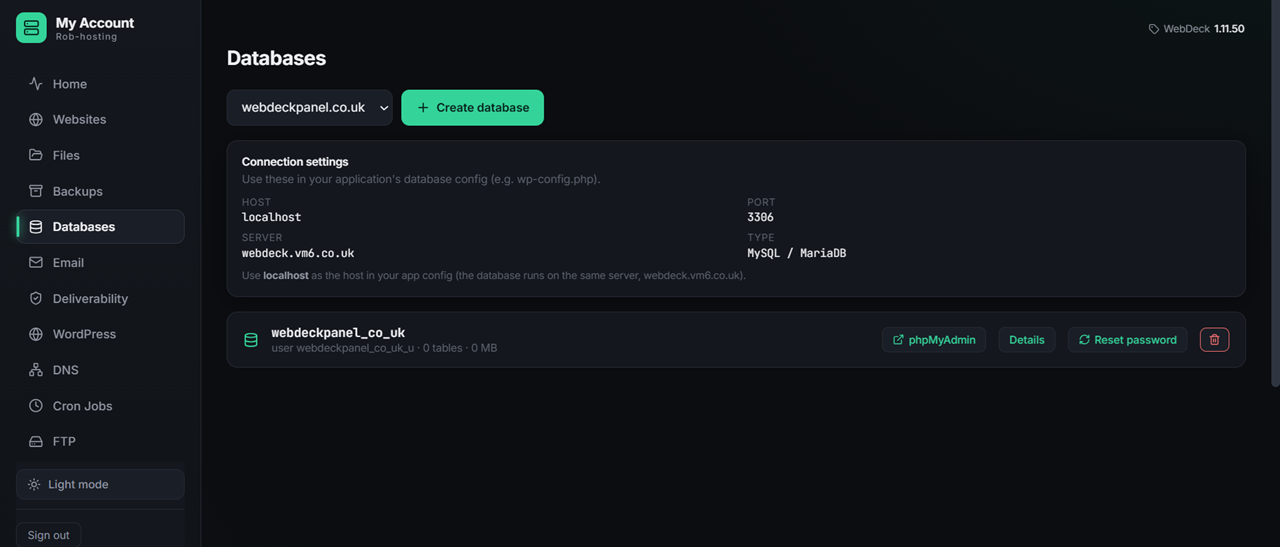
Databases & phpMyAdmin
MySQL and MariaDB, with phpMyAdmin one click away and single sign-on so nobody has to remember another password.
- Create databases and users from the panel
- phpMyAdmin built in — with single sign-on
- Scoped privileges — a user per database
- Remote MySQL — per database, for named IP addresses only, always encrypted; off until you switch it on 2.3.1
- Included in backups — dumped and restored with the site
- Or install Adminer if that's more your thing
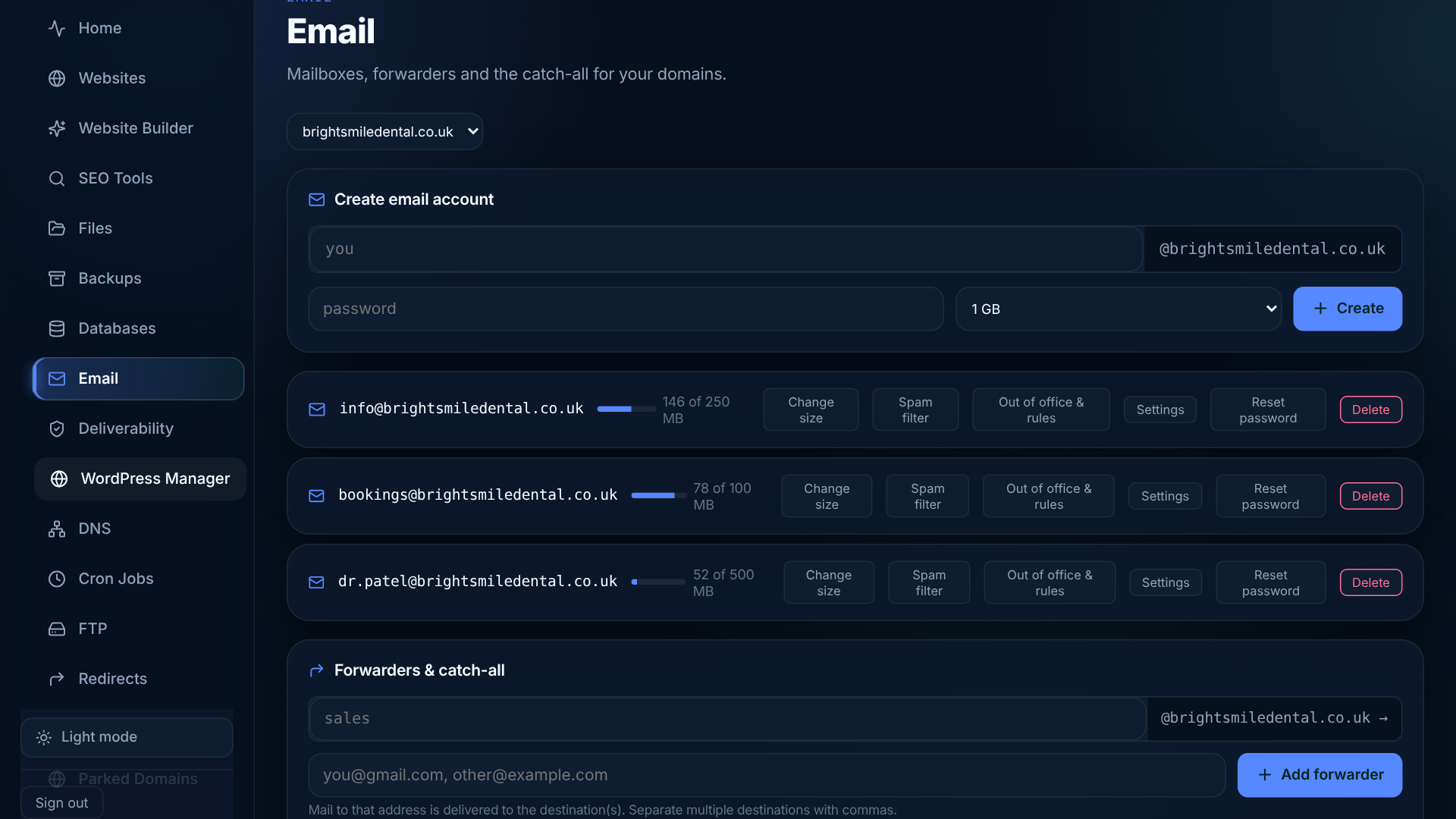
Mailbox sizes that mean something New — 2.3.0
A mailbox's size is now a real limit. A full mailbox refuses new mail politely instead of quietly filling the server's disk.
- Warnings first — the owner is emailed at 80% and 95%, and sees it in the panel
- Change size — customers make a mailbox bigger themselves, within their plan
- Size bars — every mailbox shows how full it is
- Deleting still works — Trash gets headroom, so a full mailbox can always be cleared out
- Gentle switch-over — nearly full mailboxes are given room before limits start
Websites & domains
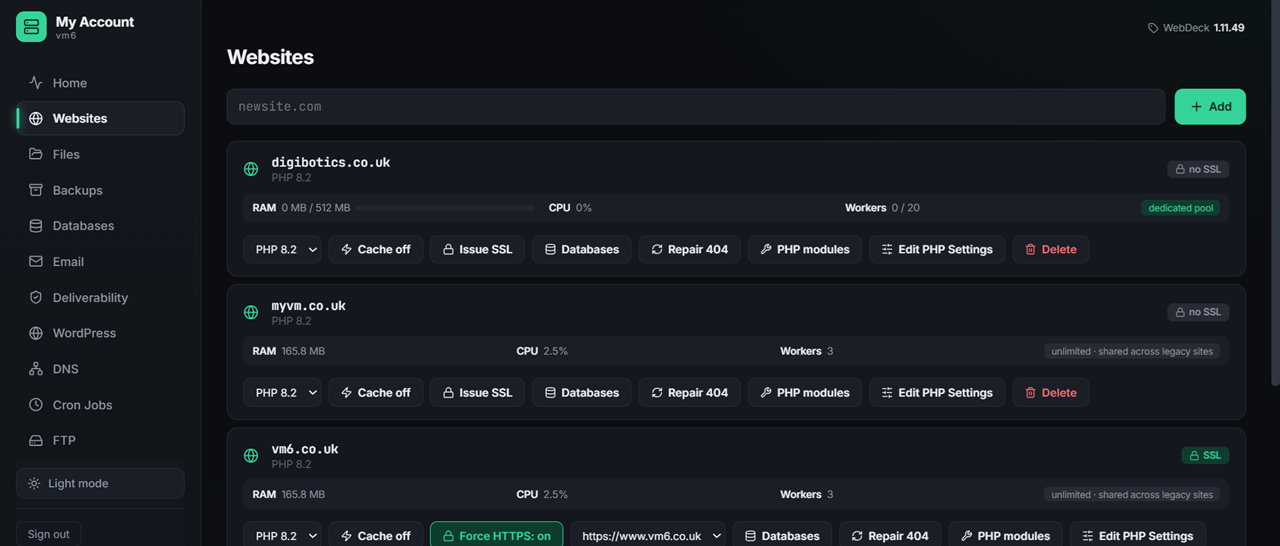
Create a site and WebDeck does the lot: virtual host, document root, PHP pool, DNS zone, SSL certificate. Then hands you the tools to run it.
- Parked domains — point extra domains at a site; fleet-checked so you can only park domains you own (2.2.9)
- One-step site creation — vhost, docroot, DNS and SSL together
- Apache, nginx or OpenLiteSpeed — switch stack without rebuilding
- Free Let's Encrypt SSL, issued and renewed automatically
- Force HTTPS per site, one toggle
- URL redirects — 301s and 302s, managed from the panel
- Page caching for an instant speed-up
- Site repair — rebuild a broken site's config in one click
- Add-on domains and subdomains
Logs, in the panel
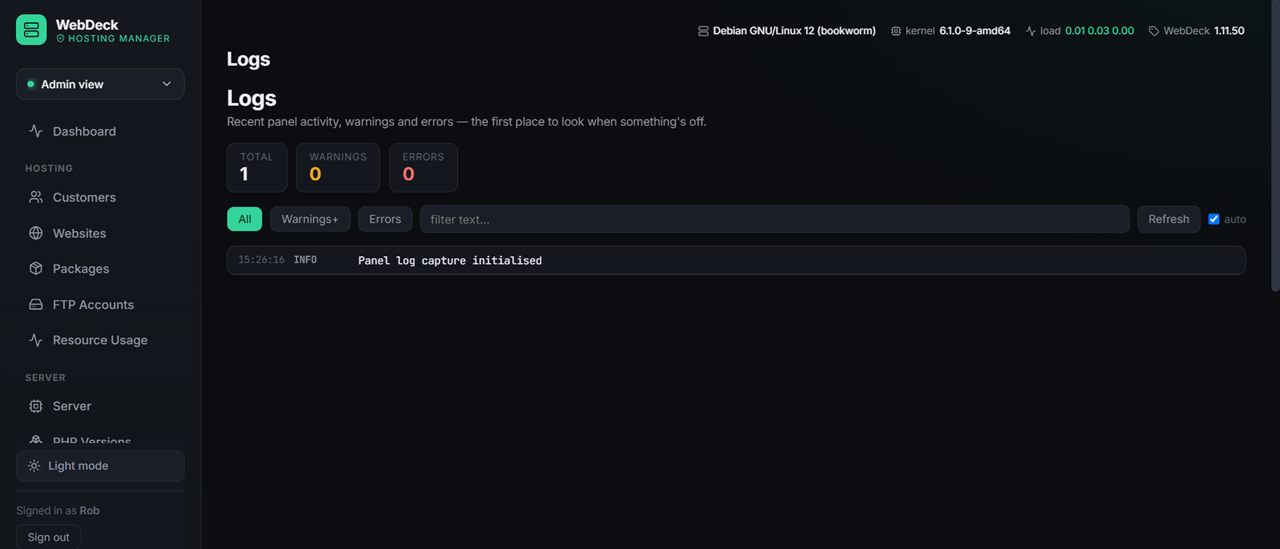
Stop SSHing in to read a log file. Access and error logs for every site, plus mail and panel logs, right where you're already working.
- Access logs per site — see every request
- Error logs per site — the PHP errors your customer is hitting
- Mail logs — trace a message that didn't arrive
- Panel logs — what WebDeck itself has been doing
- Tail the last N lines without loading a 2 GB file
- Audit log — every administrative action, who and when
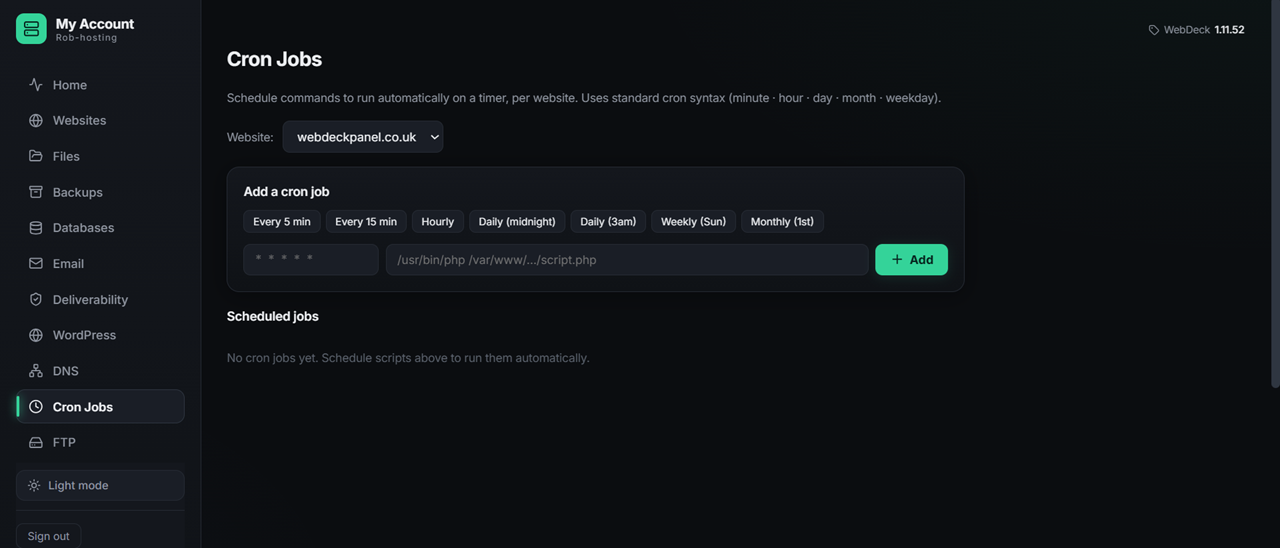
Cron jobs, made easy
Scheduled tasks without the cron syntax anxiety. Common schedules are presets; the fields are there if you know what you're doing.
- Create and edit scheduled tasks from the panel
- Presets for the common schedules — hourly, nightly, weekly
- Full cron syntax available if you want it
- Per site — each customer manages their own
- Delete a job without editing a crontab by hand
- WordPress cron — set up a real one so scheduled posts actually publish