
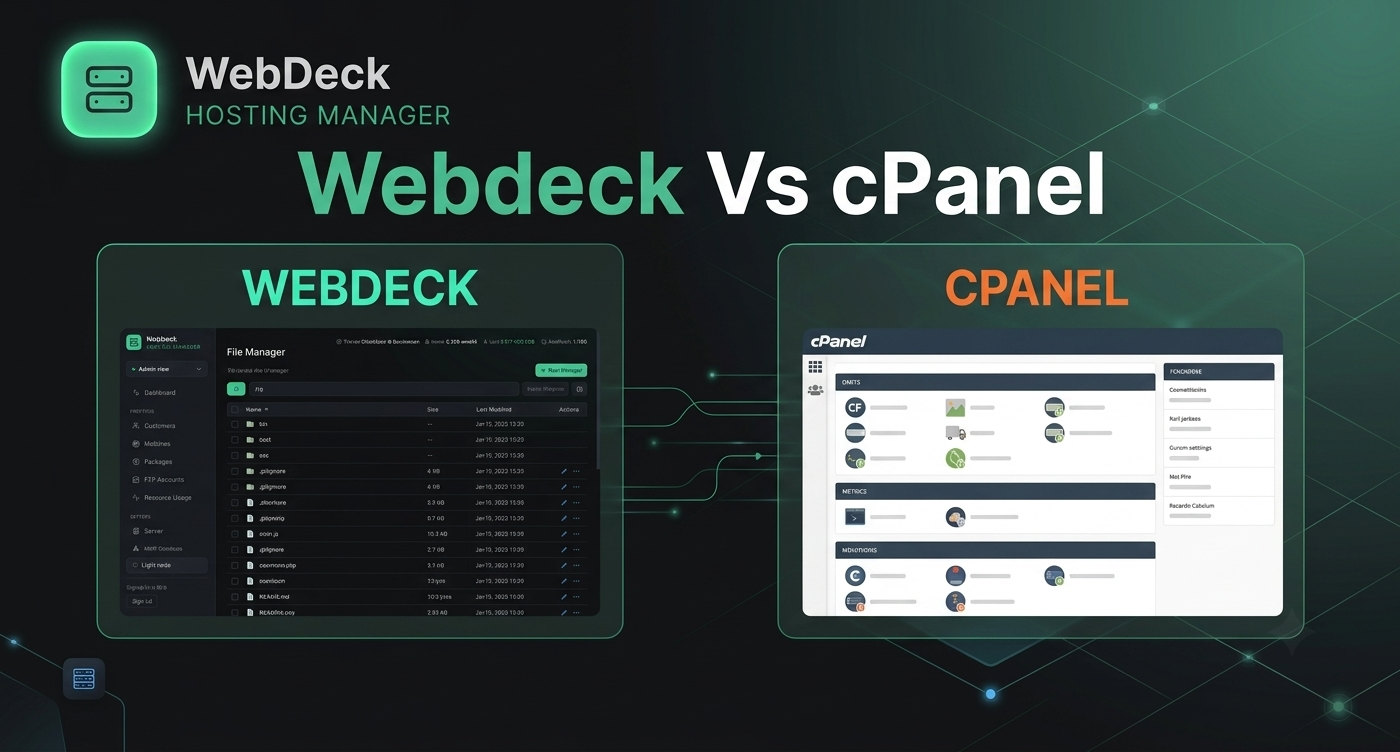
cPanel has been the default hosting control panel for over twenty years, and there’s a reason for that — it’s mature, it’s everywhere, and it just works. So can a free, newer panel like WebDeck actually stand next to it? Here’s an honest look, including the places where cPanel is still clearly ahead.
The short version
If you run a large hosting business and need decades of ecosystem, third-party integrations and a support phone number, cPanel earns its price. If you’re a smaller host, a developer, or someone tired of a licence bill that climbs every January, WebDeck gives you most of what cPanel does — plus a few things it doesn’t — for nothing. Which is right depends entirely on which of those you are.
The elephant in the room: price
This is where the conversation usually starts, so let’s be specific rather than vague. cPanel moved from flat-rate to per-account pricing in 2019, and has raised prices every single year since — cumulatively more than 55% higher than in 2019. As of 2026, the headline tiers look like this:
| cPanel tier (2026) | Accounts | Roughly per month |
|---|---|---|
| Solo | 1 | $18 |
| Admin | up to 5 | $21 |
| Pro | up to 30 | $32 |
| Premier | up to 100 | ~$49.50 |
| Over 100 | each extra | +$0.35 |
Those are licence costs alone — before your server, bandwidth or anything else. WebDeck’s equivalent column is simple: £0. It’s free to download and run, with no per-account fees and nothing that scales up as you add customers.
Where WebDeck genuinely wins
Free trusted SSL, on a free hostname Standout
Every WebDeck install gets a real certificate on a
srv-xxxx.wd-server.co.uk hostname, automatically, from the first
load. No self-signed warning to click through on a fresh box. cPanel gives
you AutoSSL for hosted domains, but it doesn’t hand you a trusted URL for the
panel itself out of the box. It’s a small thing that removes a genuinely
annoying first-run papercut.
It sets itself up in minutes
One command installs the whole stack — web server, database, mail, DNS, PHP and SSL — then a short wizard finishes the job. No licence to buy first, no marketplace account, no config files. cPanel’s installer is reliable but heavier, and you need a licence in hand before it’s much use.
It repairs itself
WebDeck has a self-healing engine that reconciles broken configs and renews certificates before you notice. cPanel is stable, but when something does drift, fixing it is usually on you.
Choice of web server, switchable later
Apache, nginx or OpenLiteSpeed, and you can switch without rebuilding your sites. cPanel is essentially Apache-centric (with nginx as a caching layer), so this is more flexible if you care about your stack.
Where cPanel is still ahead — no spin
A comparison that pretends the incumbent has no advantages isn’t worth reading. Here’s where cPanel genuinely wins, and these matter:
Maturity and stability cPanel
Twenty-plus years of production hardening across millions of servers. Every strange edge case has been hit and fixed by someone already. WebDeck is solid and improving fast, but it simply hasn’t had that long to be battle- tested. If you’re running a large business where downtime is measured in money, that track record has real value.
Ecosystem and integrations cPanel
WHMCS, Softaculous, migration tools, monitoring, security suites like Imunify360 — an enormous amount of hosting software integrates with cPanel first, sometimes only. WebDeck has its own WHMCS module and a growing app catalogue, but it can’t match that breadth yet.
Support and accountability cPanel
Paying for cPanel buys you a support team and a company on the hook. With a free panel, community and self-reliance do more of the heavy lifting. If “someone I can escalate to at 3am” is non-negotiable, that’s a point for cPanel.
Familiarity cPanel
Millions of people already know cPanel. Your customers may expect it, your staff may already be trained on it, and “it’s what everyone uses” is a real, if unglamorous, advantage. Moving to anything new has a learning cost.
Side by side
| WebDeck | cPanel / WHM | |
|---|---|---|
| Price | Free | $18–$49.50+/mo, rising yearly |
| Trusted SSL on the panel | Automatic, free hostname | Not out of the box |
| Web servers | Apache, nginx, OpenLiteSpeed | Apache (nginx as cache) |
| Self-healing | Yes | No |
| One-click apps | 38, incl. WordPress | Via Softaculous (add-on) |
| cPanel import | Built in | — |
| Maturity | Newer, improving fast | 20+ years, rock solid |
| Ecosystem | Growing | Vast |
| Formal support | Community / VM6 clients | Paid, dedicated |
So which should you choose?
Stick with cPanel if you run a large hosting operation, you rely on integrations that expect cPanel, your customers ask for it by name, or you need a support contract and someone else’s neck on the line. It’s the industry standard for reasons that are still valid.
Try WebDeck if you’re a smaller host, a developer, an agency managing your own client sites, or anyone watching that licence bill climb and wondering what you’re actually getting for the increase. You get websites, email, DNS, databases, backups, a reseller hierarchy and 38 one-click apps — with free trusted SSL as standard — and it costs nothing to find out if it fits.
The good news is the risk of trying is close to zero. Spin WebDeck up on a spare server, import a cPanel account with the built-in importer, and see how it feels. If it’s not for you, you’ve lost an afternoon. If it is, you’ve just removed a bill that only ever goes one direction.
Common questions
Can WebDeck import my cPanel accounts?
Yes. WebDeck has a built-in cPanel importer that reads standard cPanel backups and recreates the account — websites, databases, email, DNS and files. You can import a single account or migrate a whole server.
Is WebDeck really free, or is that a trial?
Genuinely free to download and run, with no per-account fees. Host with VM6 Networks and you’re licensed automatically; host elsewhere and there’s a 14-day free trial to unlock everything, then licensing options after that.
Is a free panel safe to run a business on?
WebDeck sets up standard, open software — Apache or nginx, MariaDB, Postfix, PowerDNS — and hardens it sensibly with SSL, DKIM, SPF, DMARC, fail2ban and a firewall by default. The honest caveat is maturity: it hasn’t had cPanel’s twenty years of edge cases. Trial it on non-critical sites first, as you would with any new tool.
Do I lose anything by leaving cPanel?
Your sites, databases and mail run on the same standard software either way, so nothing is locked to cPanel technically. What you’d give up is the ecosystem and formal support — which is exactly the trade-off this article is about.
Why is cPanel getting more expensive?
Since a 2019 ownership change, cPanel switched to per-account pricing and has raised fees every year — over 55% cumulatively. That’s pushed a lot of smaller hosts to look at alternatives, which is part of why panels like WebDeck exist.
See how it compares for yourself
Free to download, installs in minutes, and imports your cPanel accounts. The only thing it costs is an afternoon.